Author: admin

  • [Insight] The Wolf That Leapt Over the Wall: A Symbol of ‘Vicarious Freedom’ for Modern Society

    The public’s attention is fixed on “Nuk-gu,” a two-year-old wolf that recently escaped from a zoo in South Korea. Despite the potential danger an escaped predator could pose to nearby residents, online spaces are filled not with fear, but with overwhelming support for the animal’s “safe return” and “live capture.”

    Experts analyze this phenomenon as a form of “psychological projection” by modern individuals. For workers living in a desolate concrete jungle and a rigid social system, the wolf breaking out of its cramped cage is no longer just an animal; it has become a surrogate for the “liberation” they secretly dream of.

    Ironically, however, the South Korea that the wolf now faces is merely another form of a “giant cage.” The barren environment—where apartment complexes and highways block the path as soon as one leaves the mountains—vividly reflects the sorrow of modern people who long for freedom but constantly hit the walls of reality. By cheering for the wolf’s survival, the public is finding comfort for their own condition—living in a world where there is truly no place to rest in peace.


    Netizen Comments on the Escaped Wolf (Full Translation)

    • 해피하게살자: Please survive… How suffocating it must have been to live in a tiny cage forever. Poorly managed zoos should be closed.
    • 짱구: It must be starving and cold all night. Many people probably lost sleep checking for news. Wolfie, hurry back home!
    • 가짜루팡: Don’t die, just come back. You’re trapped because of human greed. Poor wolf, only 2 years old, still so young…
    • rapa: Please don’t kill it; capture it alive. Stop locking animals in poor facilities for entertainment. Build proper safety measures and release them into the wild where they belong.
    • 까미: I keep checking the news because I’m worried. Come back soon and have something delicious.
    • 앵두나무: Don’t kill it, please save its life.
    • 딩글이: Hope you return alive.
    • blueinyou: Please… don’t kill it!
    • 닉네임: Since the founding of this country, cases of hunters, armed criminals, or mad stray dogs killing people are far more common than wolves. Did we shoot them all on the spot? If it’s about “prevention,” who should we logically shoot first?
    • 기하와벡터: Whether you get caught or not, I hope you live out your full life. Wolfie, never attack a human, or they’ll euthanize you.
    • 한마음: Come back alive, wolf. It’s not your fault; it’s the humans’ fault. The authorities must capture it alive. O-World, can’t you manage things properly? If you’re going to use animals for money, at least keep them safe. If this wolf is shot, I will curse you forever.
    • 기하와벡터: Get rid of all zoos and aquariums. Please.
    • 대박: It’s just a baby, please don’t shoot it.
    • 우리밍키미남이달봉이키빈이: Don’t kill it. Please help it return to the zoo safely.
    • owl: Release the female too so they can meet and go to the mountains together.
    • tomipapa: If zoos didn’t exist, this wouldn’t happen. Only conservation centers should exist, not commercial zoos. Tame wolves don’t attack humans unless provoked. If you make excuses and kill it again, it’s the end for O-World. The world has changed.
    • 김동일: The whole nation is waiting for its safe return. You must not shoot it like that cougar incident last time. If you do, you’ll face national outrage. Everyone is watching. We know it’s hard, but please capture it alive even if it costs more.
    • 크레용: I feel sorry for being human.
    • bluerain: We should only see animals in large parks like Everland. It’s not right for humans to keep so many in such small cages.
    • 제비꽃: Don’t kill it. It’s a human mistake.
    • 함박눈: Wolfie! Let’s get back alive.
    • 방수: Don’t shoot! It’s a precious life, an endangered species! Wolfie, go back home!
    • 오카방고: It’s no different from the stray dogs around us. Never kill it.
    • 스마일www112: Don’t shoot. Lure the hungry, tired wolf with food back to its family. It left because the cage was so stifling. It’s all our fault.
    • SEAVET: I remember when a leopard escaped; it was scared, hiding in a drain with its ears down, but they just shot it dead.
    • 까르페디엠: Enjoy your short vacation. I wish you could live free, but it’s hard to survive in this human-redefined nature. Just hide your tracks and come back safely.
    • 레몬티: Don’t shoot, just capture. It’s still just a baby…
    • 한영주: Please save it!
    • 밍쿠s: It would be amazing if it found its way home on its own.
    • 어쩔씨구리: Run away quickly, wolf. Humans are bad.
    • 피렌체빵집: It’s only about a year old, just a baby. Don’t shoot; use a tranquilizer and find it a better environment than O-World.
    • ace: Humans made the mistake, so why shoot the wolf? Capture it and send it back.
    • 모네: Don’t kill it.
    • happiness: Hope they don’t kill it.
    • 없음321: Put yourselves in the wolf’s shoes. Imagine how stressful and painful it is to be locked in a tiny cage. Don’t kill it just for “safety.” Even if it’s an animal you dislike, killing is wrong. Death is sad.
    • 강송미: What did Wolfie do wrong? The staff were negligent. Don’t kill a poor living being.
    • qwertyuiop: Close down O-World. This isn’t the first time.
    • 슈우슈: Never kill it… it’s the fault of the people who caged it.
    • 맑을린: Shooting is absolutely not allowed. Bring it back alive!
    • dbsrud: Hope you return to your family safely.
    • 놀래미: Let’s get rid of all zoos nationwide. We don’t need to see animals like this.
    • 후레지아88: Deuk-gu (Wolfie), go back quickly. It’s hard being an outsider. You’re only happy with your own kind. O-World needs better management.
    • 닉네임을등록해주세요: They messed up, but they talk about shooting? Just save it.
    • KSJ: It must be hungry and thirsty. Isn’t there a mountain nearby? I’d rather it live freely in the mountains.
    • 휘파람: It’s not even a fierce beast, just a 1-year-old captive wolf. Why such a fuss? It’ll take time, but it can be captured. No need to shoot.
    • leejy: Just let it live in nature. Let it balance the ecosystem; there are too many water deer and wild boars anyway.
    • 공정과합리: Just say you released it and leave it alone. We used to have tigers and leopards in our mountains.
    • 웃으면복이와: Don’t kill it. The problem is O-World’s management.
    • 윤민재: Humans lost it, but they decide to kill it based on human standards? How rude.
    • 닉네임을등록해주세요: Use a tranquilizer gun! It’s a predator, but it just went out for a stroll because it missed freedom.
    • Pera: Capture it and let it live somewhere wider. Who is the mayor of Daejeon anyway? We need a change.
    • 두아들어뭉: If it had hurt someone, it would be in the news. If there’s no harm, please don’t shoot.
    • 미리내: Don’t shoot. The wolf is innocent. We shouldn’t kill it for human mistakes.
    • 스마일www112: I hope young Wolfie lives. How much more will humans sin? It’s our fault it escaped out of frustration.
    • 수국왕자: Please don’t kill it.
    • 도쏠도쏠: Don’t shoot! Humans make the mistake, then kill the animal!
    • 제비꽃: Make zoo permits much stricter so they can’t mistreat animals in poor conditions.
    • 짬뽕라면: The title mentions “considering shooting”—if they kill it and the negligent staff get off easy, I won’t stand for it as a citizen of Daejeon. It was raised by humans and isn’t aggressive. Capture it!
    • Blue: Hope they capture it alive.
    • 앞만보고달려간다: Baby… let’s go back quickly. You can’t die.
    • 최인석: Is it going through puberty?
    • Johanna: Don’t kill it!
    • chunyuheqiudongnlfu: I searched for news as soon as I woke up. It must be scared and hungry… please come back alive.
    • 송골매: Just let it live in nature.
    • 봉구엄마: Don’t shoot it like that cougar. It’s just an innocent animal.
    • TAN: Shooting? If you solve human errors with bullets, you’re not human. Bring it back alive.
    • 다이아나: So pitiful… please don’t kill it.
    • hjlee: You can’t kill it.
    • 김정훈: Wolves don’t usually hurt people; they avoid them because they’re scared. I hope they don’t shoot.
    • 범아시아: An escaped animal due to negligence is a threat to humans. Wolfie, enjoy your freedom but don’t hurt humans and just go home.
    • 아델라이드: My first time commenting. Seeing so many people caring for the wolf shows the world is still warm. Please capture it safely.
    • 닉네임을등록해주세요: Don’t worry about citizen safety; just capture it. It just wanted freedom.
    • 보리뽀리: Please, just don’t shoot…
    • 고구마캐자: Save the wolf. It’s so sad.
    • 고구마캐자: A lonely, poor wolf. It must be hungry. I hope no one mistakes it for a dog; they are actually quite scary big.
    • kim: Why the innocent wolf? Just use a Jindo dog to track it.
    • 가시고기: It lost its wild instincts in the cage, so it’s probably less aggressive than a stray dog. Don’t overreact and just capture it safely.
    • AGVpro: Just get rid of zoos.
    • 소중: Please save it. Wolfie, run far away into the deep mountains.
    • 가시고기: It just acted on instinct. At 2 years old, it’s very curious. Never shoot. Drop some food where it might be and rescue it safely.
    • 나혼자: This is bad. Watch your neighborhood dogs. Rescue the wolf safely.
    • 솔향: Hope you return alive.
    • 3867411: A wolf has appeared!
    • 생각하는대로이루어진다: Don’t shoot, please capture it. You’re hungry, let’s go home.
    • eogksalsrnr: Capture it alive. O-World’s management is so sloppy. They need a full safety audit.
    • 닉네임을등록해주세요: A romantic meeting with a female wolf… so touching.
    • 미라주: How did they manage it for it to escape? Don’t hurt it. I saw a movie about Mongolian wolves being hunted… it was so sad. One wolf ran until it collapsed just to avoid being caught. Why are we so desperate to kill them? Capture it safely.
    • 닉네임을등록해주세요: Stop talking nonsense and go catch the wolf. Your IQs are similar, so it should be easy.
    • WIND: Capture it alive. Don’t kill it like other escaped animals.
    • 최미영: Let’s go home.
    • 정신차려: Go to Mongolia, wolf!
    • 온새미로: Some people want to restore wolves to Korean mountains like the bears. Those people should go catch this one. Just don’t get bitten.
    • 아까징끼: Wolf, run far away along the Baekdudaegan mountains. Live freely in the forest.
    • 언제나그랬듯이: It’s actually kind of cute. Hope it lives freely in nature.
    • 오스텔라: It won’t be easy, but please capture it alive. I wish zoos would disappear.
    • 스텔: How scared it must be… please don’t shoot.
    • 고령독수리식당: Let’s use a net. Are there any cowboys?
    • 닉네임: What kind of name is “Wolfie” (Nuk-gu)? Is your son’s name Sam-gu? Why not cool names like Nuk-BTS or Nuk-Psy?
    • 남덕현: Don’t worry about citizen safety. It won’t cause harm. Just let it live in nature.
    • 남덕현: Just leave it alone. Does the fire department have nothing to do? Restore the wolf population in the mountains.
    • 윰?윰?: Don’t hit the cute wolfie.
    • 저대삼: You people can’t distinguish between beasts and humans.
    • 핑크소라: Get rid of cramped zoos. If you must, make a safari. I’m against zoos!
    • 핑크소라: Worried about innocent Wolfie… it’ll be shot if an accident happens.
    • 우수한인재: Enjoy nature to the fullest and return safely… please don’t die.
    • 에코모카: The wolf is innocent.
    • 쳐키: If it breeds with stray dogs, the population will explode. You can’t go to the mountains anymore. Who manages things like this?
    • camsun: Don’t kill it, I wish it could run far away, but wolves are social animals so it might come back.
    • dlag: I saw a report that it was caught yesterday—is this a different wolf? Or was that fake news?
    • 신동근: Not a single line about punishing the zoo for the negligence? Does a tiger have to escape for it to matter?
    • 신복부하: If it was raised by humans, it’s probably like a dog.
    • 뽀통령만세: Let’s get back safely.
    • 맑을린: Fence off a whole mountain and let it live there.
    • 하나비: Moon Jae-in ordered the cougar to be shot. He’s a devil.
    • 대확행: Run far away from humans. Never get caught.
    • 손수건: People wanting to close zoos should first stop keeping pets. Ban dogs and cats first. I’m tired of this “PC” talk.
    • 따르릉112: Go to the mountains! You can survive there… have babies with a stray dog.
    • 수달: The wolf’s safety is important, but residents’ safety comes first! Find it quickly!
    • 참을인인인: Stray dogs are scary enough in the mountains. If someone gets hurt, then what? Catch it fast.
    • 태지: This case is interesting, but I wish they’d share real-time updates for safety via emergency texts.
    • 도서관: Only sick or animals that can’t survive in the wild should be kept in zoos for care.
    • 바다: Follow the scent of flowers back home. It might be stifling, but the world is more dangerous. Please don’t use force or shoot.
    • 하루: Use a “honey trap” (female wolf). Capture it safely before a big accident happens and you’re “forced” to shoot. Where are the animal rights groups?
    • 인터스텔라: Must save it.
    • 파란볼펜: Using a female to lure it? I guess the “honey trap” still works.
    • 라라: The zoo should be closed. This is the second time; trust is gone.
    • 김효식: Wolves are smart; I believe it will find its way back.
    • 장제영: Can’t they lure it with the keeper’s voice and some meat?
    • 플러스: It could be dangerous if it meets a pet.
    • 스카이폴: Believing in homing instincts and waiting? Using a female wolf? Is this for real? This is a “parade of fools.”
    • 꽃은심어무엇해: It must be hungry. Throw it [Specific Politician/Person Name].
    • BB: Come back after you’ve played enough. I’ll take you for walks.
    • 닉네임을등록해주세요: Now if they release a female, there will be two… if they wait for the homing instinct, they might come back with ten pups. How relaxed of them.
    • 애플옆키위: It might run into a Bone Soup restaurant.
    • 블랙맘마: Who takes responsibility if someone gets hurt? Catch it.
    • 그렇지: Never die. Go to Mt. Gyeryong. If you’re hungry, you can eat the “2-voters” (political slang). Just eat them; they aren’t human anyway.
    • 파라곤: What kind of nonsense is this? Waiting for homing instincts? Releasing a female? Are you serious?
    • 스데반: It’ll adapt to the wild in a few days. Catch it now.
    • 에필로그: Everyone gets so sentimental and pretends to be a “good person” at times like this.
    • 푸르른날: Deploy a massive team and shoot it immediately!
    • JOYongJin: Don’t regret it after someone dies. Shoot it. It can’t be helped.
  • Why Koreans Eat Soup with Every Meal

    Why Koreans Eat Soup with Every Meal

    Korean meals almost always include soup, and many people wonder why Koreans eat soup with every meal.

    Why Koreans Eat Soup with Every Meal

    Many people wonder why Koreans eat soup with every meal, especially when they first experience Korean food culture.

    There’s a saying in Korea that “you can only really have a meal if there’s soup.” It may sound a bit exaggerated, but for many Koreans, a meal without soup somehow feels incomplete.

    Why is that?

    First, Korean meals are centered around rice. Rice by itself is quite plain and dry, so eating it alone can feel a bit difficult. Soup helps moisten the rice and makes it easier to eat. Taking a spoonful of rice with some soup naturally creates a better balance in both texture and taste.

    Also, soup plays a role in balancing the overall meal. Korean food often includes various side dishes, some of which can be salty or strongly flavored. Soup helps to soften those flavors and refresh the palate in between bites.

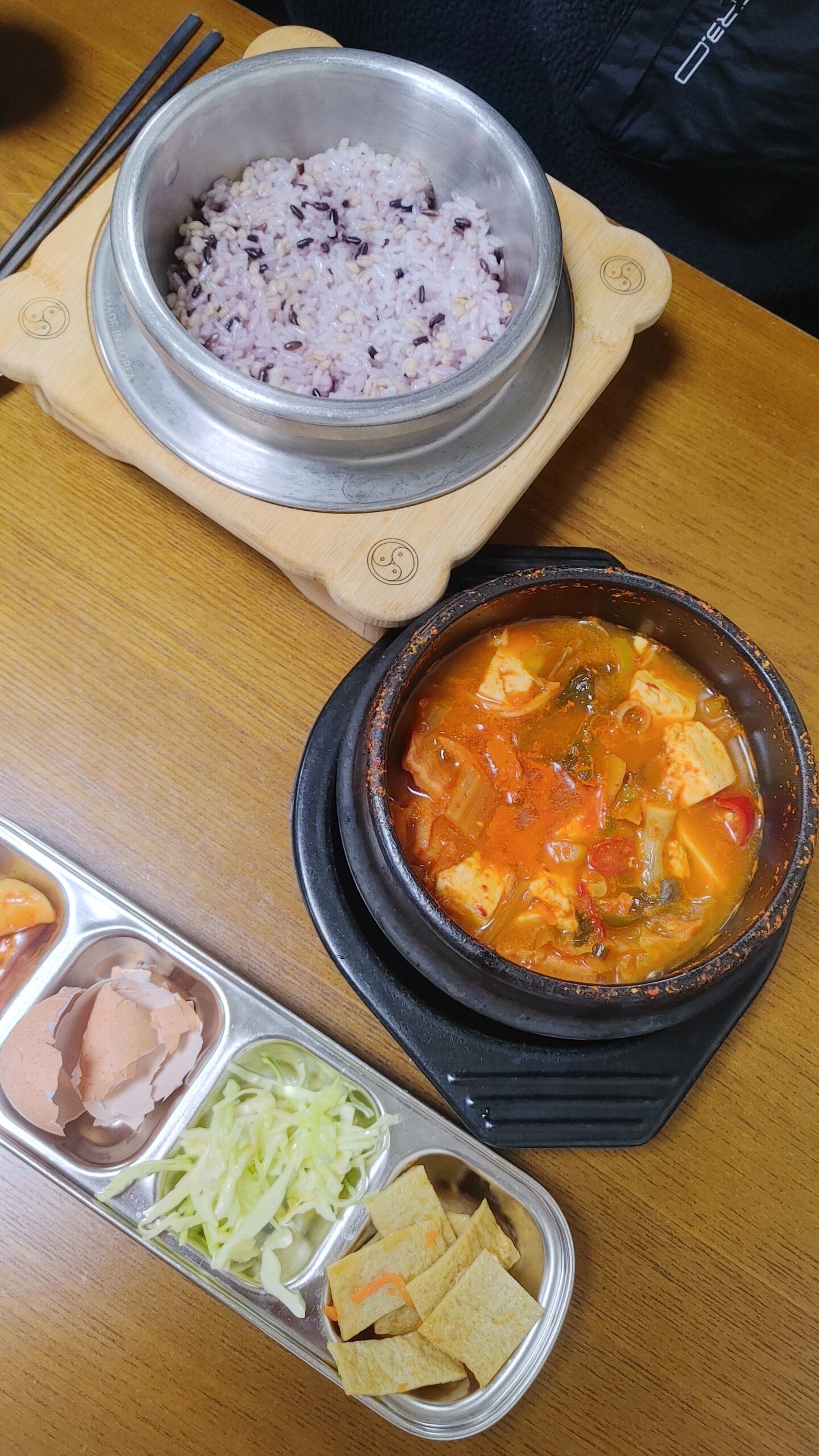
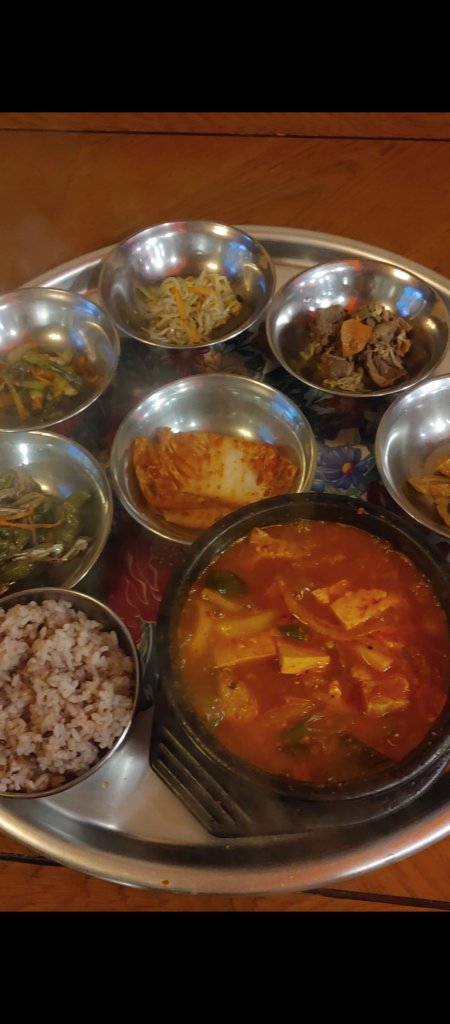
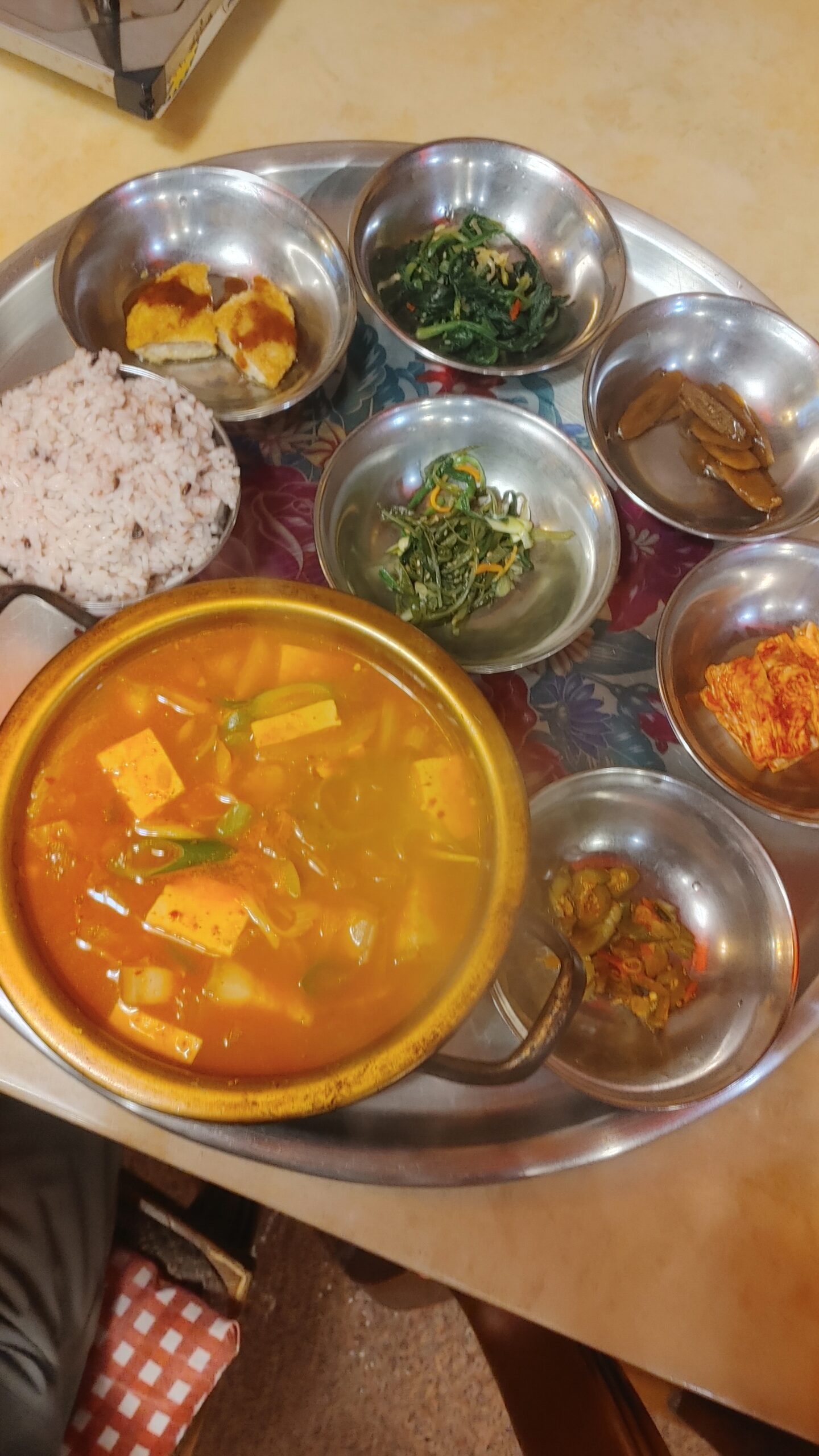
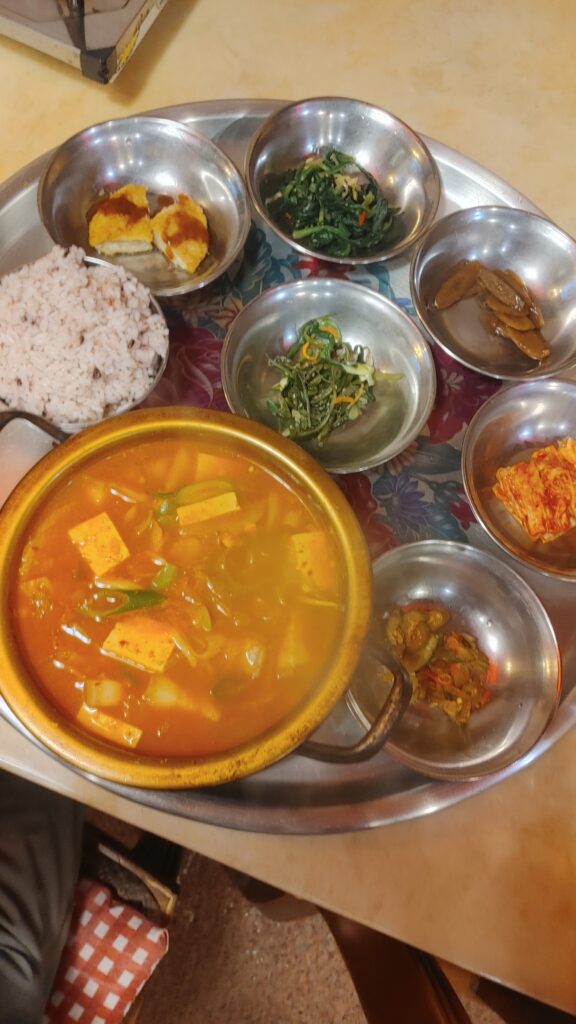
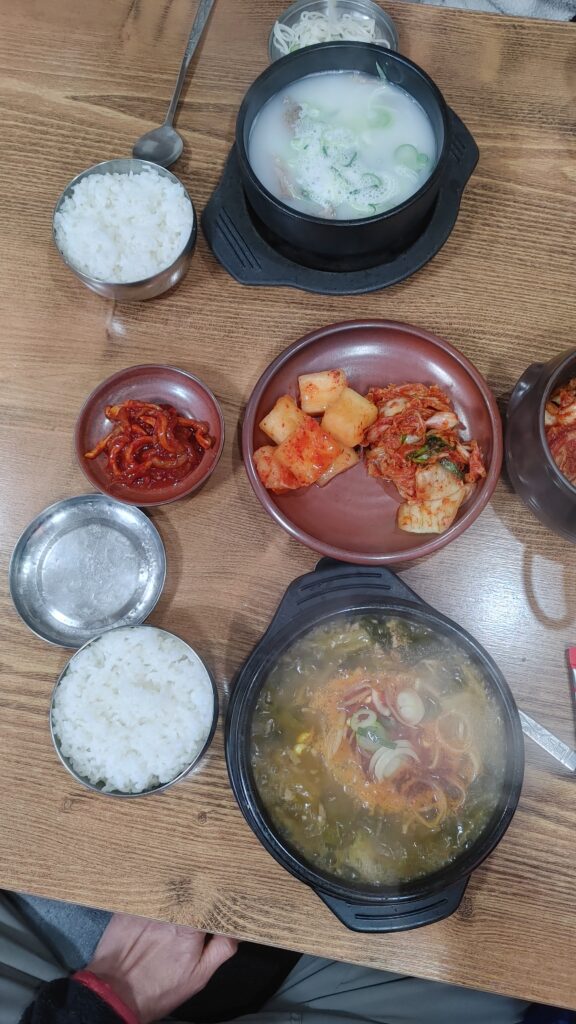
    Korean meal with soup and rice - hanjungsik
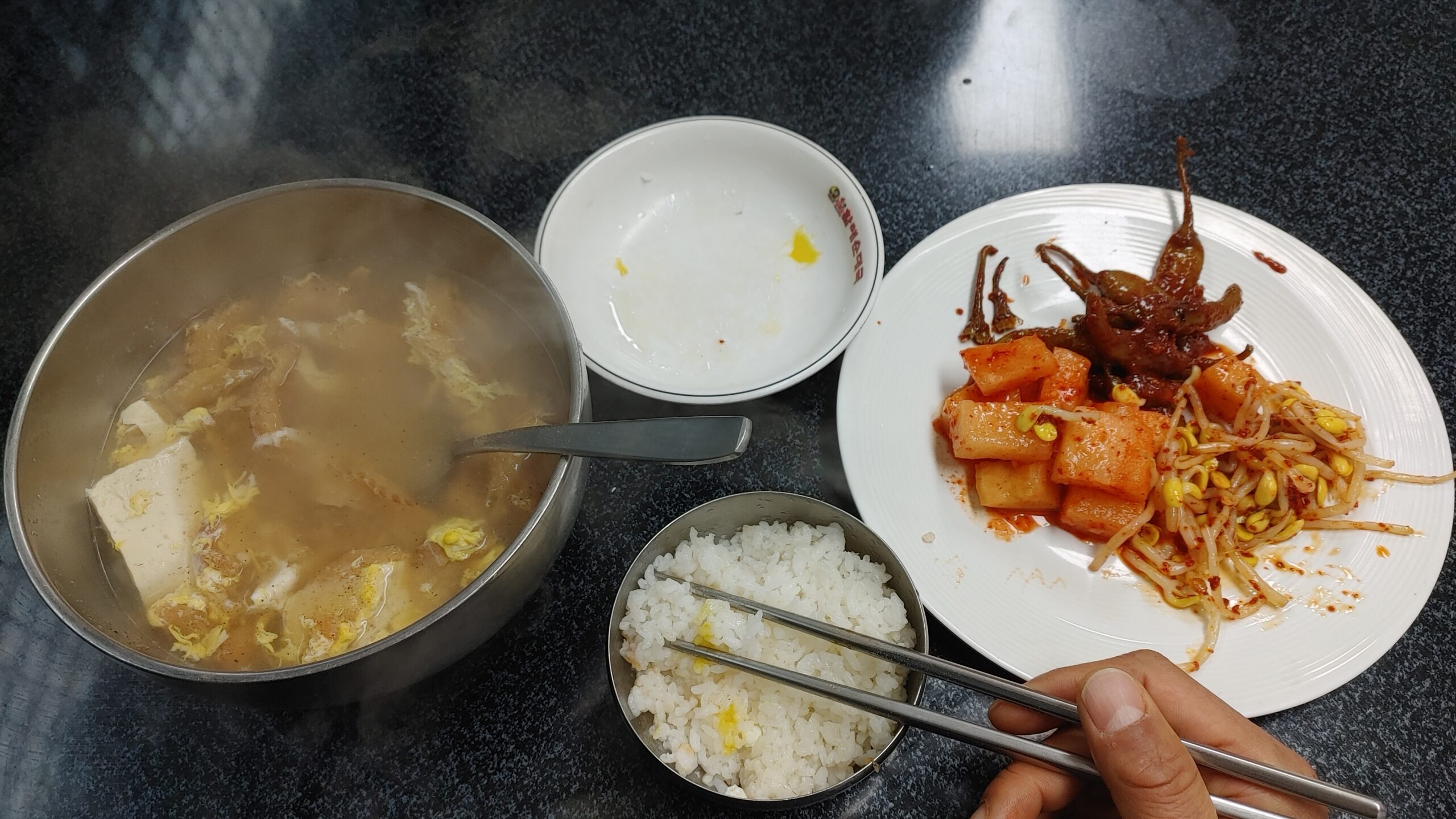
    Today Lunch – 9$

    Another reason is habit formed over a long period of time. Traditionally, Korean meals have always consisted of rice, soup, and side dishes. This structure has been passed down for generations, becoming a standard way of eating. Because of this, many people feel that something is missing if soup is not present.

    There is also a practical side. Soup can be made with a wide variety of ingredients—vegetables, tofu, meat, or seafood—making it a convenient way to add nutrition to a meal. A single pot of soup can provide warmth, hydration, and nourishment all at once.

    For many Koreans, a meal simply doesn’t feel complete without soup.

    In many cases, soup or stew is placed at the center of the table and shared. This naturally creates a sense of togetherness, as everyone eats from the same dish while having their own bowl of rice. Meals become not just about eating, but about sharing and connecting.

    Because of all these reasons, soup is not just an optional side in Korean cuisine. It is an essential part of the meal, something that completes the experience of eating.

    So when Koreans say, “You need soup to have a proper meal,” it’s not just a preference—it reflects a long-standing cultural habit.

    In Korean cuisine, soup is not served as a starter, but as a main part of the meal alongside rice.

    In Korean cuisine, soup is served as part of the main meal alongside rice.

    What should I have for dinner tonight?

    Even though I am Korean, I leave work habitually pondering: “What soup should I make?” and “Since I already have the usual side dishes, should I make one unique one?”

    Since side dishes can be eaten multiple times, I do not prepare a new dish for every meal. Even when I make soup, it is not just eaten once and then finished; it is often eaten again at the next meal.

    Korean food consists of soup, rice, and various seasonal side dishes. In a sense, you can think of Korean food as the raw ingredients grown in Korea throughout the four seasons.

    “Want to learn more about Korean food culture?”

  • Korean Dining Etiquette: Why Koreans Eat the Way They Do

    Korean Dining Etiquette: Why Koreans Eat the Way They Do


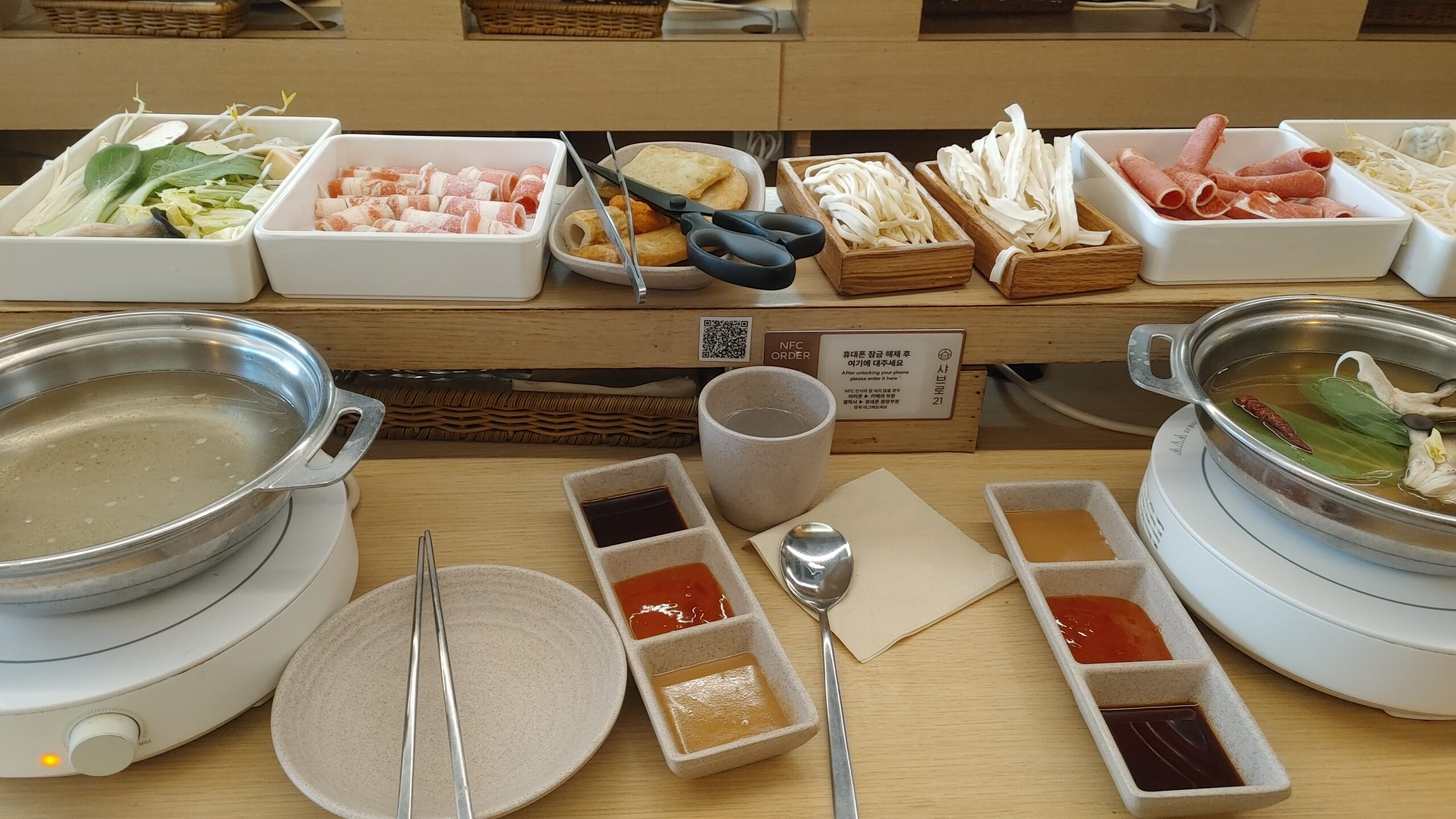
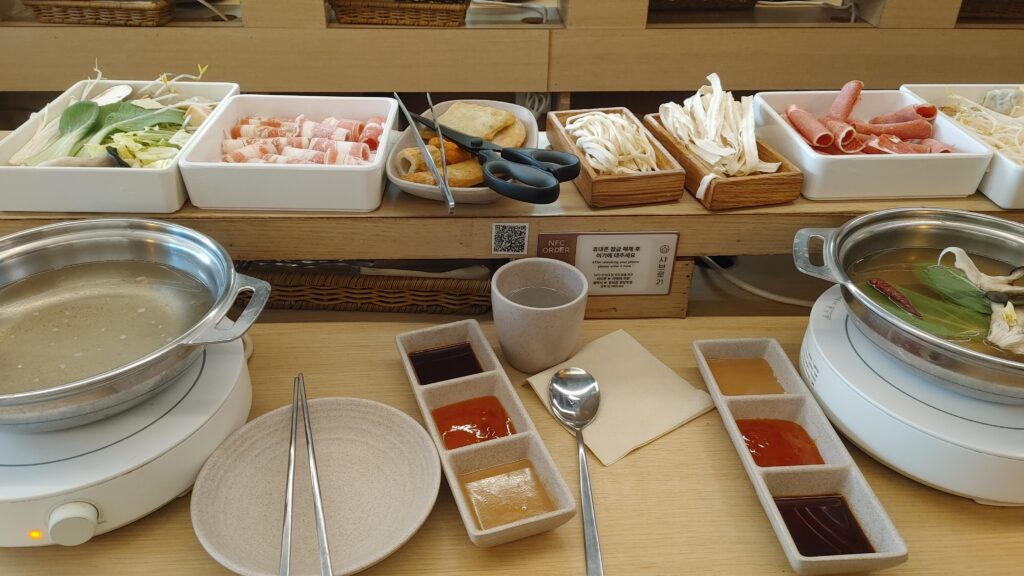
    with my sons - With my son at a single-serving shabu-shabu restaurant - Location: Hongdae Station
    with my sons – With my son at a single-serving shabu-shabu restaurant – Location: Hongdae Station

    Korean dining etiquette is unlike anything else in the world — distinct not only from Western table manners, but also from those of neighboring China and Japan. A traditional Korean table is set with an abundance of side dishes, everyone shares a communal stew from the same pot, and the order in which you pick up your spoon actually matters. So how did Korean dining etiquette come to be this way — and what does it tell us about Korean culture?

    The Unwritten Rules at the Korean Table

    Even as Korean food culture has evolved over the decades, certain foundational rules at the dinner table remain deeply embedded in everyday life. These aren’t arbitrary customs; they are the living expression of Confucian values that have shaped Korean society for centuries.

    Growing up in a Korean household, I experienced this firsthand. Every evening when my father came home from work, my mother would have dinner ready. The children were expected to be seated at the table first. Only when my father sat down and reached for his spoon — his sujeo — would the rest of the family begin eating. The eldest or most senior person at the table always lifts their spoon first. No one eats until they do.

    This simple act carries tremendous meaning: it is a gesture of respect for the person who provides for the family, a quiet acknowledgment of the day’s hard work. It is rooted in Confucian tradition, and for many Korean families, it is still observed today.


    No Loud Eating, No Heated Arguments

    One of the most distinctive aspects of Korean table manners is the expectation of quiet, mindful eating. Koreans are taught from a young age not to make noise while chewing and to keep their mouths closed when eating. There is an old saying that eating with your mouth open will drive away good fortune (bok) — so Koreans tend to eat carefully and quietly.

    Conversation at the dinner table tends to be gentle and measured. The eldest typically leads the discussion, and exchanges often resemble a soft check-in — the elder asks, the younger responds. Heated debates and arguments at the dinner table are considered inappropriate. The meal itself is the priority.

    In my childhood home, my mother always set aside the first scoop of freshly cooked rice — the warmest, most fragrant portion — specifically for my father’s bowl. She kept it warm in the rice cooker until he arrived home. It was a small act, but it spoke volumes: a daily ritual of love and gratitude from a wife to a husband who worked hard to support a family of six.


    Why Koreans Use Both a Spoon and Chopsticks

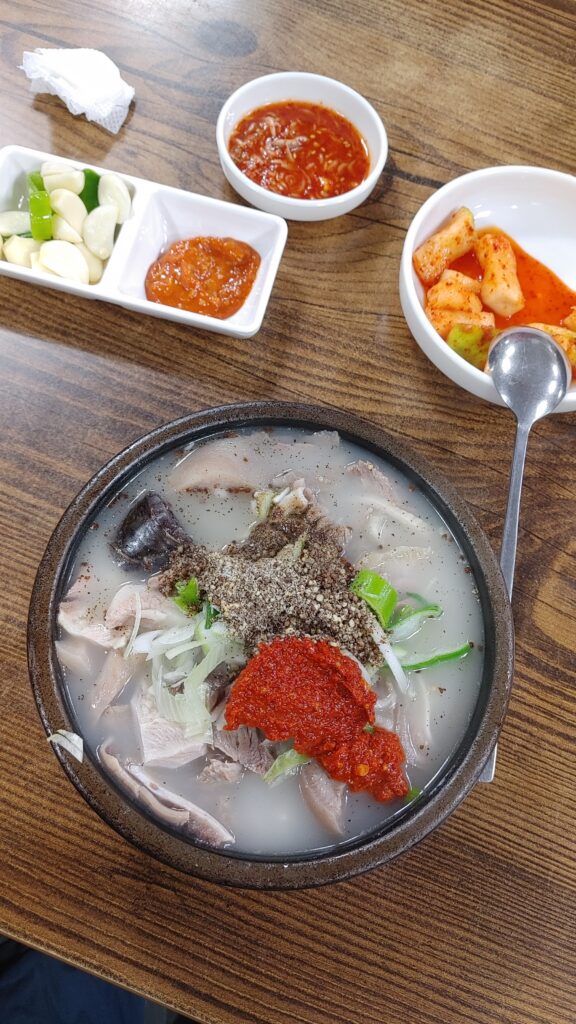
    Today Lunuch - Korean dining etiquette table setting
    Korean-style tripe soup for lunch – Location: Yeouido, South Korea

    If you’ve ever sat down at a Korean restaurant and noticed both a long-handled metal spoon and metal chopsticks beside your bowl, you may have wondered — why both?

    According to the Korea Cultural Promotion Institute, the combined use of the spoon (숟가락, sutgarak) and chopsticks (젓가락, jeotgarak) — collectively called sujeo — evolved directly from Korea’s soup-centered food culture and its grain-based diet.

    • The spoon is used for rice and broth. Korean meals are built around guk (soup) and jjigae (stew), making a spoon indispensable for scooping liquid-heavy dishes.
    • The chopsticks are used to pick up side dishes (banchan) and solid foods.

    This is what sets Korea apart from Japan and China, where chopsticks alone are typically used for rice. Korean rice, while slightly sticky, is eaten with a spoon alongside a bowl of soup — a habit refined over many centuries of Korean culinary tradition.

    Another reason for metal utensils goes back to the royal court and Joseon Dynasty (1392–1897), when silver spoons and chopsticks were used specifically to detect poison in food. Silver reacts visibly to certain toxins, making it a practical safety measure for those serving royalty. The preference for metal utensils eventually spread throughout Korean society, reinforcing hygiene standards — metal is easier to sanitize than wood, especially in a culture centered around broth and soups.


    The Art of Setting a Korean Table

    In traditional Korean table setting, every item has a designated place:

    • Rice bowl is placed to the left.
    • Soup bowl goes to the right of the rice.
    • Spoon and chopsticks are placed to the right side of the soup bowl.
    • Banchan (side dishes) are arranged in the center of the table so everyone can reach them comfortably.
    • Special or freshly prepared dishes are placed at the center front — the position of honor and easy access.

    This arrangement is not accidental. It reflects a philosophy of communal generosity — the food belongs to everyone at the table. Sharing banchan from common dishes is a hallmark of Korean dining culture, one that often surprises Western visitors who are accustomed to individual plating.

    Traditionally, Korean families ate seated on the floor (jwasik culture), with a low table set on the warm ondol floor. As modernization brought Western-style furniture into Korean homes, dining chairs and elevated tables gradually replaced the floor-sitting tradition — though the values underneath remained the same.


    “Let’s Grab a Meal Together Sometime” — More Than Just Food

    In Korean culture, the phrase “언제 밥 한번 같이 먹자” (“Let’s eat together sometime”) carries far more weight than a casual lunch invitation. It is an expression of wanting to connect, to share, to build a relationship.

    Korean meals serve as the backdrop for nearly every significant social interaction:

    • Family bonding — parents checking in on children, spouses catching up after long days.
    • Friendship and community — school moms gathering at a restaurant to share parenting advice over doenjang jjigae.
    • Romance — couples sharing their first meals together as a way of deepening emotional intimacy.
    • Business relationships — deals discussed, trust built over shared samgyeopsal and soju.

    Eating together is the fundamental social glue of Korean life. Sharing food — especially food you’ve cooked yourself — is one of the most powerful ways to say: “I care about you.”


    The Rise of “Honbap” — Eating Alone

    Yet something is shifting. In 21st-century Korea, the phenomena of honbap (혼밥, eating alone) and honsul (혼술, drinking alone) have become increasingly mainstream — especially in major cities like Seoul. Rapid urbanization and industrialization have reshaped the rhythms of daily life, pulling families apart and pushing meals into the individual sphere.

    When I was a child, it was common for friends or my father’s colleagues to be invited into our home for a shared meal. Today, that kind of hospitality has largely moved to restaurants. Even within families, eating together has become a special occasion rather than a daily habit. We hear phrases like “Let’s make more time to eat together as a family” — a sign that something once taken for granted is now something we have to consciously protect.

    The individualization of Korean meal culture is real. But the longing for connection at the table remains.


    Keeping the Tradition Alive, One Meal at a Time

    As a father of two, I make it a point to cook for my children whenever I can. The food might not be restaurant-quality, but it’s food I’ve chosen with care — made with simple, wholesome ingredients, free from anything harmful. More importantly, it’s food made with intention and love.

    Korean dining etiquette isn’t just a set of rules about where to place your spoon. It is a living record of how Koreans have expressed respect, love, hierarchy, and community through the act of eating. Understanding these traditions gives you a far richer window into Korean culture than any guidebook can offer.

    The next time someone says “밥 한번 먹자” to you — take them up on it. There’s a whole world of meaning in that shared meal.

    💡 Part of our Guide to Korean Dining Culture This article is a deep dive into Korean Dining Etiquette. It explores how Confucianism and communal values shape the way Koreans eat, from the use of metal chopsticks to the philosophy of sharing.

    Related artices


    Q: Is it okay to lift your bowl while eating in Korea?

    A: No, in traditional Korean etiquette, lifting your rice or soup bowl is considered impolite. This is a key difference from Japanese dining culture. Bowls should remain on the table, and you should use your spoon to eat.

    Q: Why are Korean chopsticks usually made of metal?

    A: Historically, silver was used in the royal court to detect poison. Today, metal is preferred for its hygiene and durability, especially when eating or wash dishes

  • How to Choose Good Korean Soy Sauce

    You’re right — let me redo this much closer to the original voice, keeping it personal and natural without over-structuring it.


    How to Choose Good Korean Soy Sauce

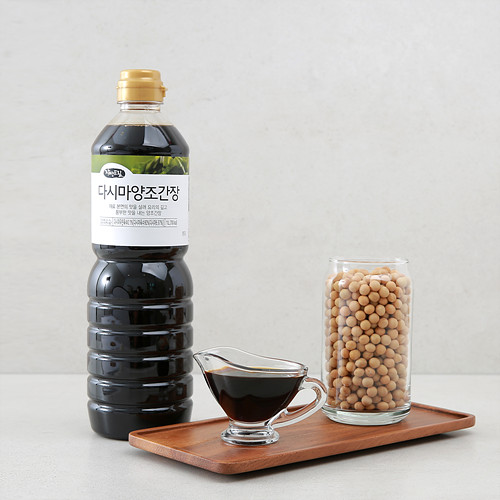
    I’ve been thinking about the soy sauce that influencers use when they make Korean food videos on YouTube and TikTok these days. I wanted to share this for anyone around the world who loves Korean food — how to find a soy sauce that’s actually good for you.

    As a Korean, let me walk you through how to choose a good one.

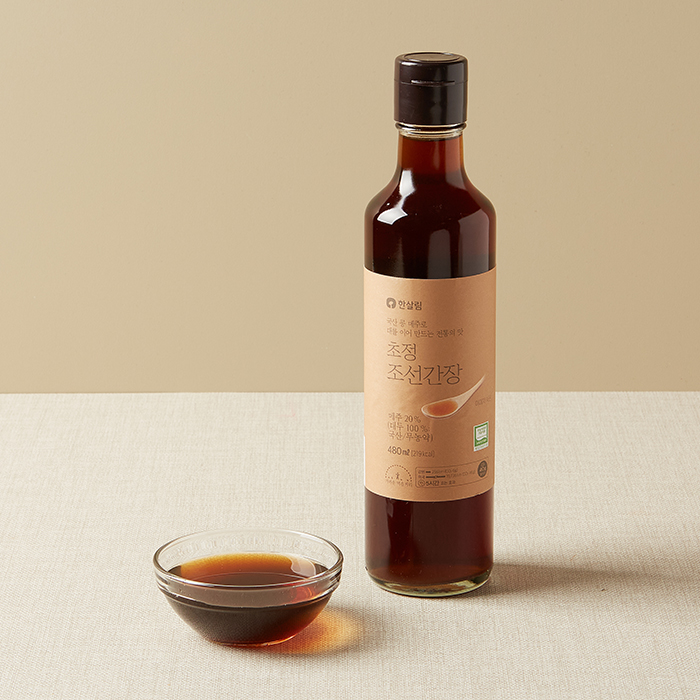
    So what makes a soy sauce “good”? Let me explain. A very long time ago in Korea, there was only one kind of soy sauce. Back then, the main ingredients were meju (soybeans boiled, mashed into a specific shape, and left to develop the mold needed for fermentation), salt, water, and a fermentation jar called a jangdok — that was all. Charcoal is also added during the process. The reason charcoal goes in is that its microscopic pores are known to absorb bitter flavors and off-odors, improving the overall taste. It acts as a natural preservative, helping to remove impurities and keep the soy sauce from spoiling. My mother always added charcoal when she made soy sauce. It’s not an absolute requirement, but it’s a common part of the traditional process.

    So the main ingredients of a truly good soy sauce are: soybeans (boiled and shaped into blocks, then stored in the shade until mold develops — this is what we call meju), salt, water, and charcoal. That’s it. Soy sauce made this traditional way is commonly called joseon ganjang. In Korean cooking, the main seasoning used when making soups is either plain salt or joseon ganjang. It makes the flavor cleaner while also giving it a deep, rounded taste.

    (A little side note: if you’re feeling bloated or your stomach is unsettled, try boiling some napa cabbage and seasoning it with 2 tablespoons of joseon ganjang. It can soothe your stomach and leave you with a warm feeling spreading through your body.)

    If you want to make joseon ganjang at home, you’ll need to allow time for fermentation — usually somewhere between 1 and 3 years, and some people age theirs for up to 10 years. That’s how precious it was. Every household used to make their own, and it was considered the most important sauce in the home. Joseon ganjang can be stored for a long time as long as mold doesn’t develop — in Korea, it’s traditionally kept outdoors in earthenware jars. No refrigeration needed.

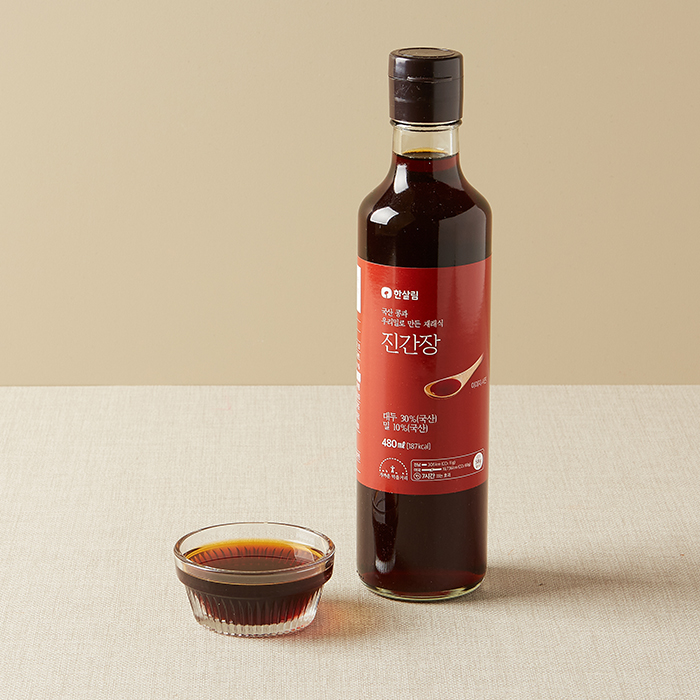
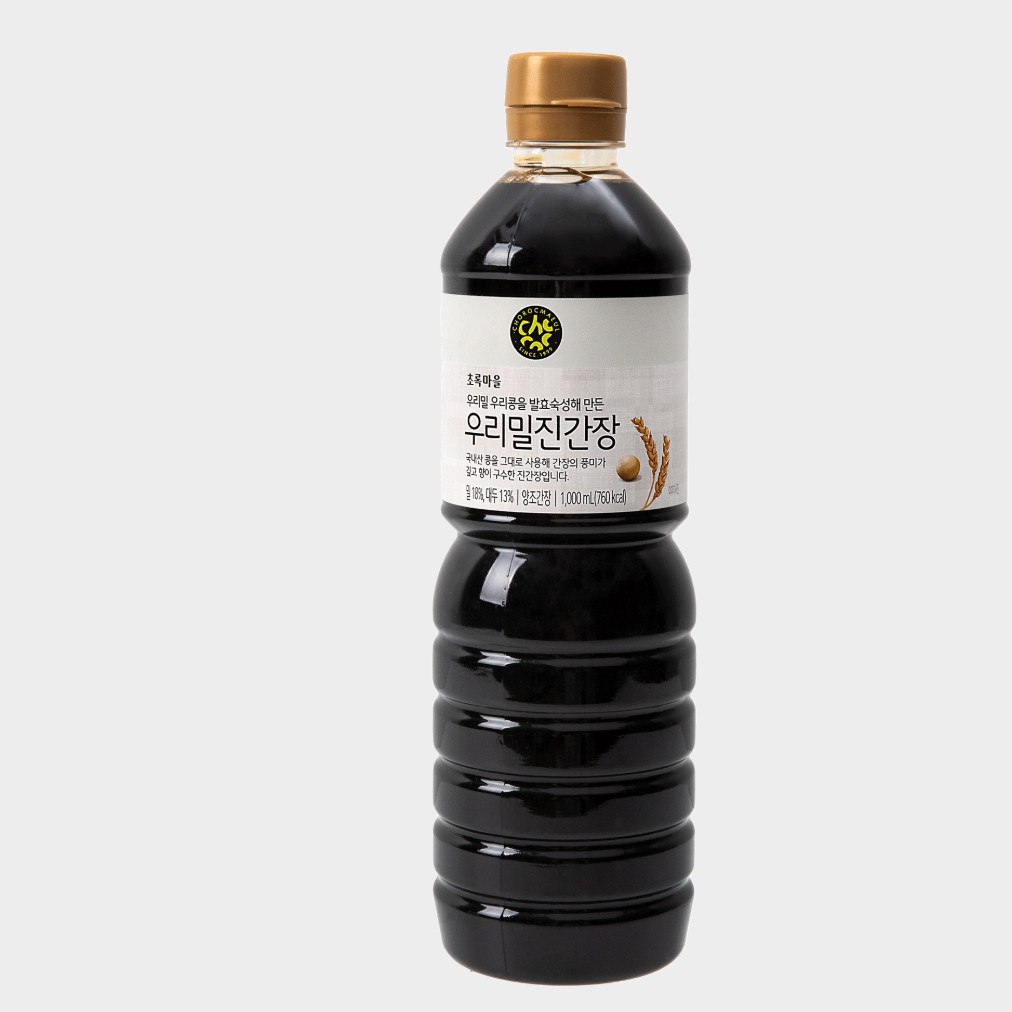
    If you’re outside Korea and want to try joseon ganjang, it may not be easy to find. Production is limited, and you’re much more likely to come across jin ganjang. The difference is this: joseon ganjang is the raw, unseasoned sauce in its pure form, while jin ganjang is soy sauce that has been seasoned and crafted for flavor. Most of what you see on supermarket shelves is jin ganjang.

    That said, if you’re buying jin ganjang and want something closer to natural ingredients and better for your health, here’s what to look for. A lot of products are mass-produced these days, and jin ganjang is no exception. The key is to check the label for 100% soybean-fermented yangjo ganjang with a TN (Total Nitrogen) index of 1.5% or higher, which is considered premium grade. Products with fewer additives — no caramel coloring, no flavor enhancers — and that use whole soybeans rather than defatted soybeans are the better choice. From there, you can use guk ganjang and yangjo ganjang according to what you’re cooking.

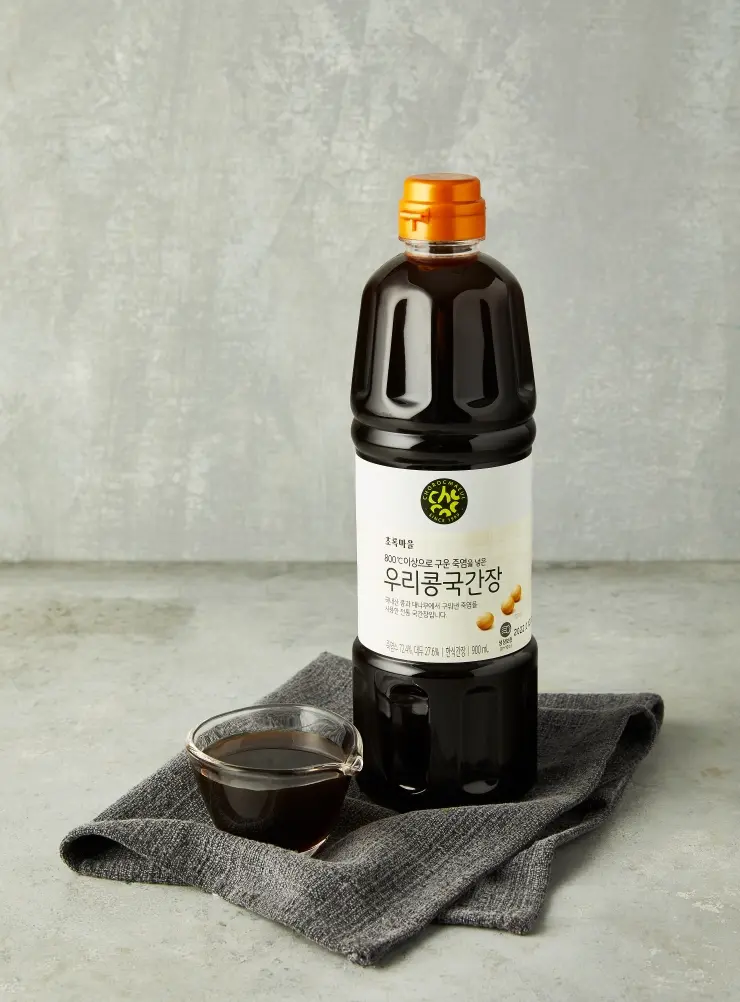
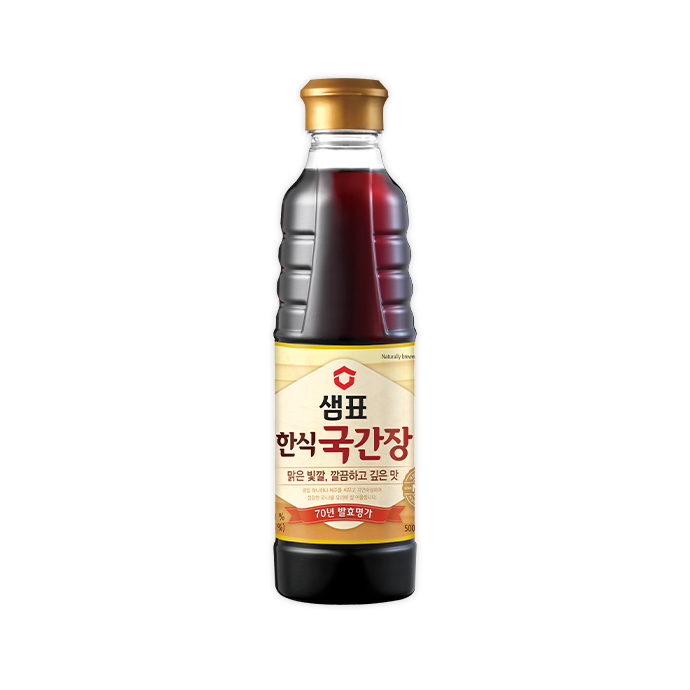
    In Korea these terms get used interchangeably, so here’s a quick breakdown: Joseon ganjang = guk ganjang = used for soups Jin ganjang = used for seasoned dishes and stews Yangjo ganjang = brewed soy sauce with an emphasis on umami

    By dish: For soups and stews, use guk ganjang (joseon ganjang) — light in color and strong in saltiness. This is what I personally recommend, and it’s what I cook for my own kids. For seasoned salads and bibimbap, use yangjo ganjang — fragrant with a pleasant sweetness. For braised and stir-fried dishes, use jin ganjang — heat-stable and rich in color.

    When buying at the supermarket, here’s what to check:

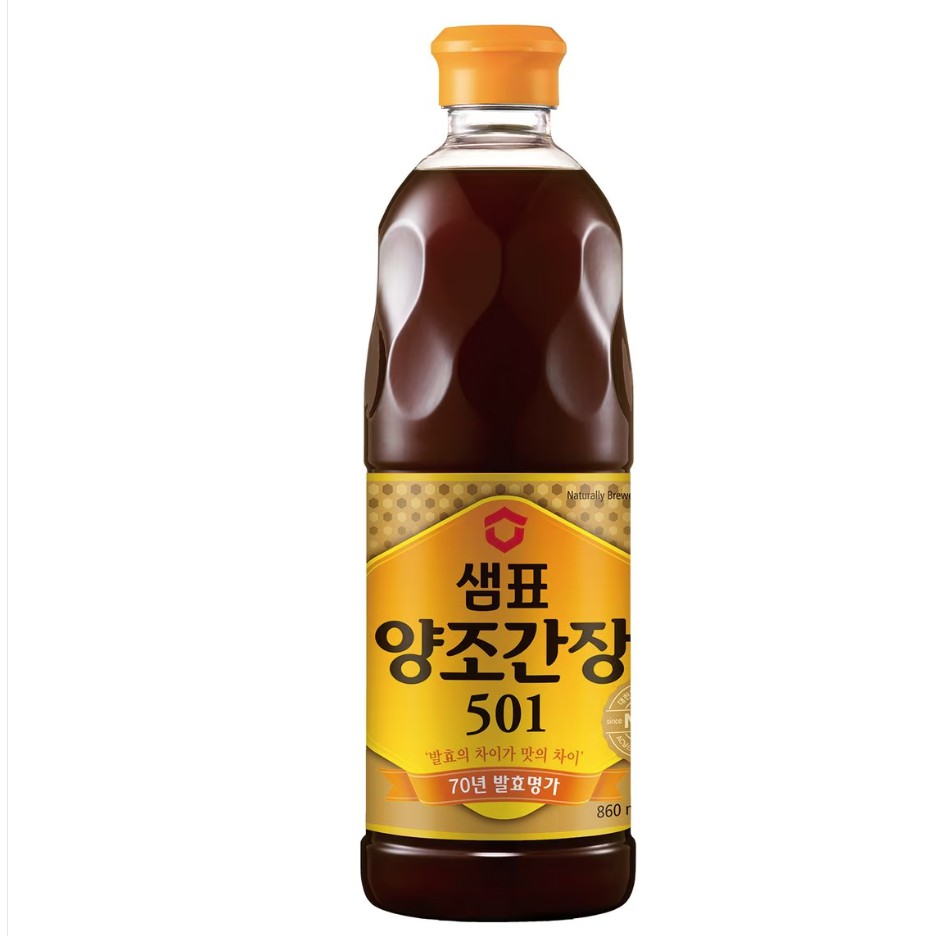
    Look at the TN index on yangjo ganjang — the higher it is, the better the quality and umami. Go for 1.5% or above (premium grade) or 1.7% or above (gold grade). Haessaldamun Ssi-ganjang Gold and Sempio 701 are both 1.7%+. Sempio Korean Soybean Yangjo Ganjang sits at 1.5% but has a high domestic soybean content.

    Check the ingredients. “Defatted soybean” (탈지대두) means the leftover pulp after oil has been pressed out — avoid it. Look instead for products labeled simply “soybean” (대두) or “meju bean” (메주콩). The shorter the ingredient list, the better. Ideally just soybeans, salt, wheat, and fermentation alcohol — with as few additives as possible.

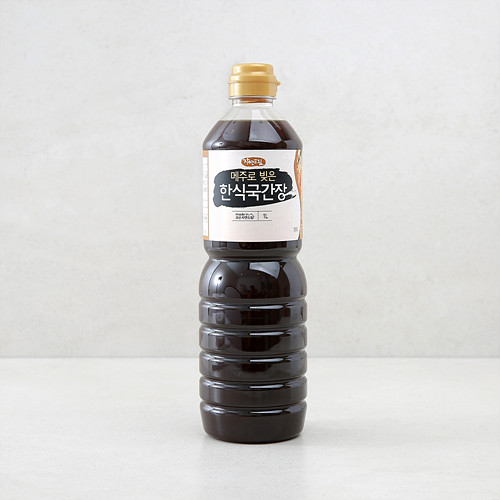
    For yangjo ganjang: Haessaldamun Ssi-ganjang Gold and Sempio 701. For jin ganjang: Haessaldamun Jin ganjang Gold and Sempio Jin ganjang Gold are the best options based on their ingredient labels. For guk ganjang: look for products labeled hansik ganjang (한식간장) or joseon ganjang (조선간장).

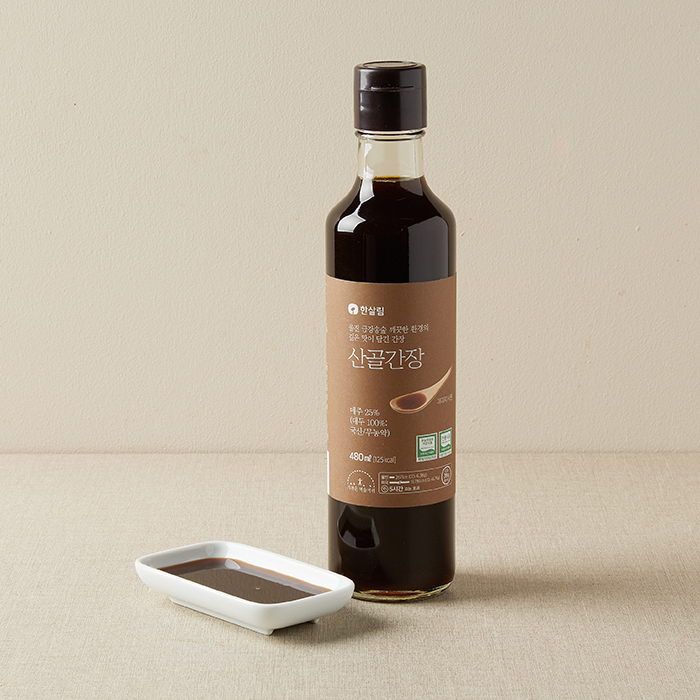
    What to avoid: blended soy sauce (혼합간장) and acid-hydrolyzed soy sauce (산분해간장). Even a product that’s 90% acid-hydrolyzed and only 10% brewed soy sauce can legally be sold as jin ganjang — so always check that the label says yangjo ganjang, not just jin ganjang.

    ❌ What to Avoid

    • 혼합간장 (blended soy sauce) — often a mix of just 10% brewed soy sauce with 90% acid-hydrolyzed soy sauce (산분해간장), yet can still legally be labeled as jin ganjang. Always check that the label says 양조간장, not just 진간장.
    • 산분해간장 (acid-hydrolyzed soy sauce) — made using industrial hydrochloric acid rather than natural fermentation. Skip it.

    If you’re not in Korea, my honest recommendation is to just go for joseon ganjang. No chemicals, no artificial flavoring — just the pure, original taste of soy sauce. If it tastes too salty on its own, you can balance the overall flavor of a dish by combining it with other sauces. Honestly, joseon ganjang doesn’t leave you feeling heavy or bloated afterward. It can run a little salty, so always taste as you go and add accordingly. It also works beautifully in simple seasoned vegetable dishes like spring cabbage or cucumber salad — just half a spoon in place of salt, and it leaves a savory, lingering depth that’s hard to describe.

    I’ll be showing you more in Part 2, with actual photos taken at the supermarket. Stay tuned.

  • Korean food culture explained : Rice and Soup

    Korean food culture explained : Rice and Soup

    Korean food culture, Rice and Soup My Menory is basic

    From my earliest childhood memories — family meals, ancestral rites, everyday dinners — my mother always prepared rice and soup. Traditionally, the Korean table is built around these two essentials. At minimum, there must be either a clear soup (guk) or a hearty stew (jjigae). That was simply the way my mother cooked, and it was the way her mother cooked before her.

    Alongside these come kimchi and an assortment of side dishes. Simply put, a Korean meal without broth feels strangely incomplete — even today, home cooks and restaurant chefs alike begin meal planning by asking themselves: what soup should I make?

    baekban - kimchi JJigae
    baekban – kimchi JJigae

    The importance of soup runs so deep in Korean culture that it even shaped the language. The expression “gungmul-do eopda” — literally “not even broth” — means having absolutely nothing left to offer. It signals the end of goodwill, the point where nothing remains between two people. In a single phrase, it captures total severance. That one idiom speaks volumes about just how central soup is to the Korean way of life — so much so that many Koreans today still say they simply cannot eat a meal without it.

    Perhaps because of this deep cultural affinity for broths and soups, Korean cuisine has developed an extraordinary variety of them. There are soups tied to special occasions: miyeokguk (seaweed soup) for birthdays, tteokguk (rice cake soup) for Lunar New Year, and torankuk (taro soup) for Chuseok. There are hangover soups like kongnamul-guk (bean sprout soup) and sundaeguk (blood sausage soup). And then there are the countless everyday soups enjoyed at the family table — too many to count. Every Korean has a personal favorite they’ve known since childhood. Mine, in my later years, is sundaeguk — unpretentious seasoning, a good balance of carbohydrates and protein, and easy on the wallet.


    korean food culture : Is Soup Culture Truly a Defining Feature of Korean Food?

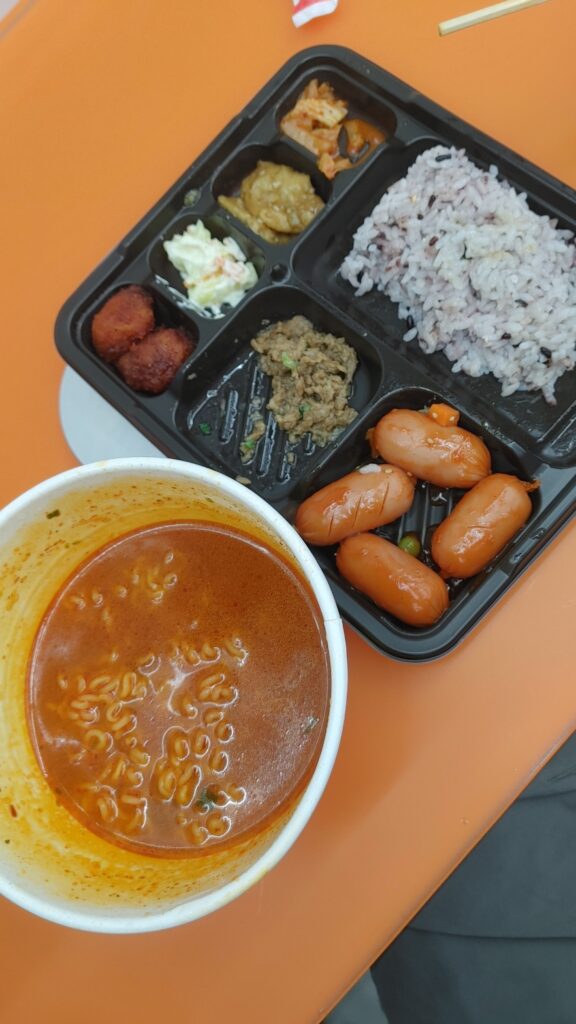
    convient store, i alway buy dosirak and Cup ramen with soup
    In convient Store south korea (my favorite menus)

    It’s worth pausing to think this through. Yes, Koreans love soup and broth-based dishes. Yes, Korean cuisine offers an extraordinary range of them. But does that alone make soup culture a defining characteristic of Korean food?

    In Korean cooking, soup (guk) generally means water seasoned with a base — typically joseon ganjang (traditional Korean soy sauce) or salt — with a main ingredient added and simmered.

    By that definition, soups aren’t unique to Korea. Western cuisines are full of them: thick soups, stews (stew), porridge, broth, consommé, chowder, and purée. Chinese and Japanese cuisines are equally rich in boiled and simmered dishes — tang in China, shiru in Japan. Even the cookware has evolved alongside these traditions; specialized pots of all sizes exist across cultures to accommodate everything from a single serving to a family feast.

    So why do we still point to soup as something distinctly Korean?

    What Makes Korean Soup Culture Different

    The answer lies not in the soup itself, but in where it sits at the table.

    Consider the traditional meal structures of each culture. China follows il-tang-samchae (一湯三菜): rice, one soup, three side dishes. Japan follows il-jeup-samchae (一汁三菜): the same structure. In both cases, soup is listed alongside the side dishes — it is one element among several.

    Korea, however, follows il-sik-samchan (一食三饌): one meal with three side dishes. Notice that soup isn’t mentioned — because in Korean dining, soup isn’t counted as a side dish at all. It is simply assumed to be there, as inseparable from rice as a needle is from thread, or a fork from a knife.

    While China and Japan treat rice and soup as distinct components of a meal, Korea treats them as a unified pair. Of course, Koreans don’t always manage to prepare soup — sometimes a meal is just rice with one or two side dishes. But the ideal, the default expectation, is that rice and soup arrive together. Whether eating at a restaurant or at home, the two belong together as one.

    This isn’t simply about Koreans liking broth, or about there being many varieties of soup. It’s about a meal structure passed down from our ancestors, from our mothers’ mothers — a quiet cultural inheritance that shapes every table, every day.

    Why Did This Soup Culture Develop?

    A nation’s food culture is shaped by many forces working together — history, economy, geography, and climate all leave their mark.

    At the most basic level, soup likely developed as a way to make food more enjoyable. As Korean cuisine evolved, soups and stews emerged both independently and as companions to other dishes.

    Another reason: soup helped people eat more rice. It may sound odd to modern ears, but from a historical perspective, this makes perfect sense. Some have argued that Korean soup culture grew out of scarcity — that because the Korean peninsula is mountainous and arable land was limited, water was added to whatever ingredients were available to stretch meals further. However, Korea was not historically a chronically impoverished nation. And in practice, soup doesn’t reduce rice consumption; it actually encourages eating more of it. A meal with soup leads to more rice being eaten, not less. In that sense, soup was a food of abundance — a feature of refined, upper-class dining.

    The more compelling reason for Korea’s flourishing soup culture may simply be the centrality of rice itself.

    Korean food culture developed around rice. At the center of every meal sit rice and soup, with kimchi as a constant, surrounded by meat dishes and vegetable side dishes. Look closely, and you’ll notice that nearly every side dish exists to make that bowl of plain, unseasoned rice taste better and go further. The seasoning in side dishes isn’t excessive — a mother’s careful hand balances the salt so that one spoonful of rice paired with one bite of side dish creates just the right flavor. I know this firsthand: when I prepare meals for my own children, I always season the side dishes lightly, with exactly that balance in mind.

    P.S. What should I make for the kids tonight? Trying to decide between side dishes or soup — a small daily dilemma that I suspect every parent in the world shares.

  • Why Korean Food Is Special: Fermentation, Jang, and the Wisdom of Korean Mothers

    Why Korean Food Is Special: Fermentation, Jang, and the Wisdom of Korean Mothers

    People remember places in different ways. Most of us build our memories of a space primarily through sight — which is why the first thing we do when we arrive somewhere new is pull out our phones and take photos. I used to be the same way. But my thinking has changed. When it comes to remembering a place, smell is just as powerful as sight.

    Every Country Has Its Own Cuisine — and Korea Is No Exception

    Every country in the world has its own unique foods. These dishes are shaped by a region’s distinct climate, the vegetables, produce, and meats that grow in that climate, and the cooking and preservation methods that climate demands.

    As a native Korean, I don’t think of Korean ingredients as particularly extraordinary — they’re simply what I grew up with. But if I had to name a single element that defines the flavor of Korean food, it would be jang (장류): ganjang (soy sauce), gochujang (red pepper paste), and doenjang (fermented soybean paste).

    Korea’s geography plays a major role too. Winters can drop to -15°C to -20°C, while summers climb above 30°C. Nearly half the country is covered by mountains and forests, and three sides of the peninsula border the sea. This landscape gave rise to a cuisine built on wild mountain greens used in namul (vegetable side dishes), and seasonings born from salt, meju (fermented soybean blocks), and the slow alchemy of fermentation — ganjang, doenjang, and gochujang.

    The Taste of Jang: A Foundation Unlike Any Other

    These days, most people buy their jang from supermarkets. But from my own memories growing up, ganjang, doenjang, and gochujang were the bedrock of every meal.

    What many people don’t realize is that traditional jang is not sweet. Its sweetness sits far below that of refined sugar — which is why older Koreans so commonly say, “Food these days is too sweet.” Restaurant food has drifted that way, and in my experience, Seoul-style food tends to taste noticeably sweeter than the food from Gyeongsang Province where I’m from.

    Korean Food and Its Closest Cousin

    Among world cuisines, I find Japanese food to be the most similar to Korean. Dishes like katsu, udon, and various rice-based meals share a familiar rhythm — and indeed, Japanese katsu and udon are now commonplace in Korea as well.

    Looking at what’s trending in Korea today under the label of “fusion,” the picture has shifted considerably. Traditional ingredients are increasingly being replaced or supplemented by cheese, imported vegetables (like cilantro), oyster sauce, and hot sauce. My reference point for “traditional Korean food” is rooted in what I ate growing up — a time before mayonnaise, oyster sauce, hot sauce, cheese, sausages, or imported spices were widely available or accessible.

    What to Eat If You Want to Experience Real Korean Food

    If you’re visiting Korea and want to experience its cuisine in its most authentic form, I recommend ordering jeongsik (정식) — a traditional Korean set meal.

    The elements that make Korean food globally distinctive are, at their core: rice (in its many varieties), gochujang, doenjang, ganjang (aged), and jeotgal (salted fermented seafood). Add to that kimchi, sesame oil, and perilla oil, and you have the soul of Korean cooking. Each region adds its own layers, and seasonal ingredients grown on Korean soil bring a rotating variety of flavors throughout the year.

    Even within a single category — say, gochujang — the taste and nutritional profile can vary enormously depending on how it’s made. Some gochujang uses wheat-based sweeteners; others don’t. The name is the same, but the flavor is a different world.

    Rice as the Foundation

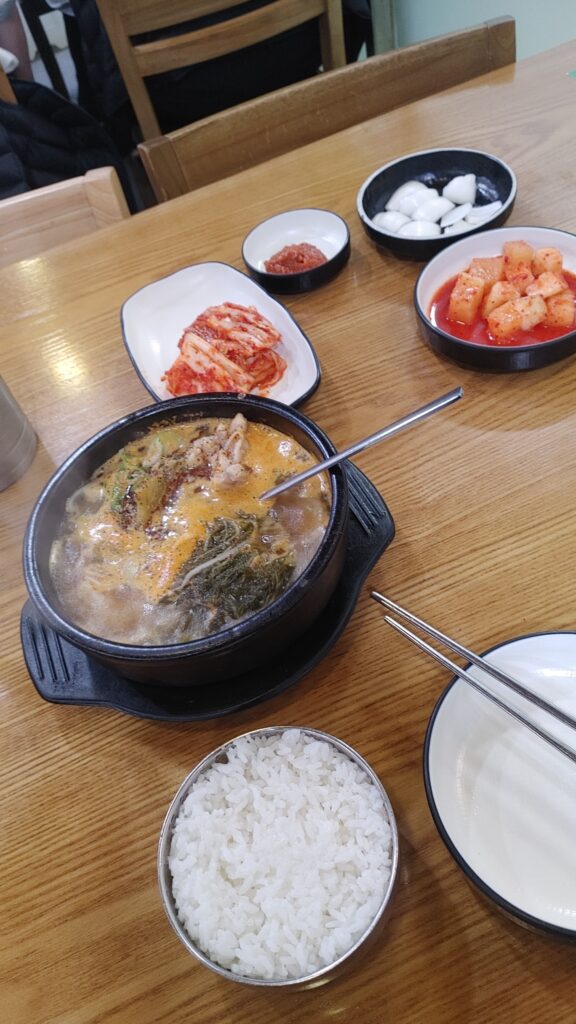
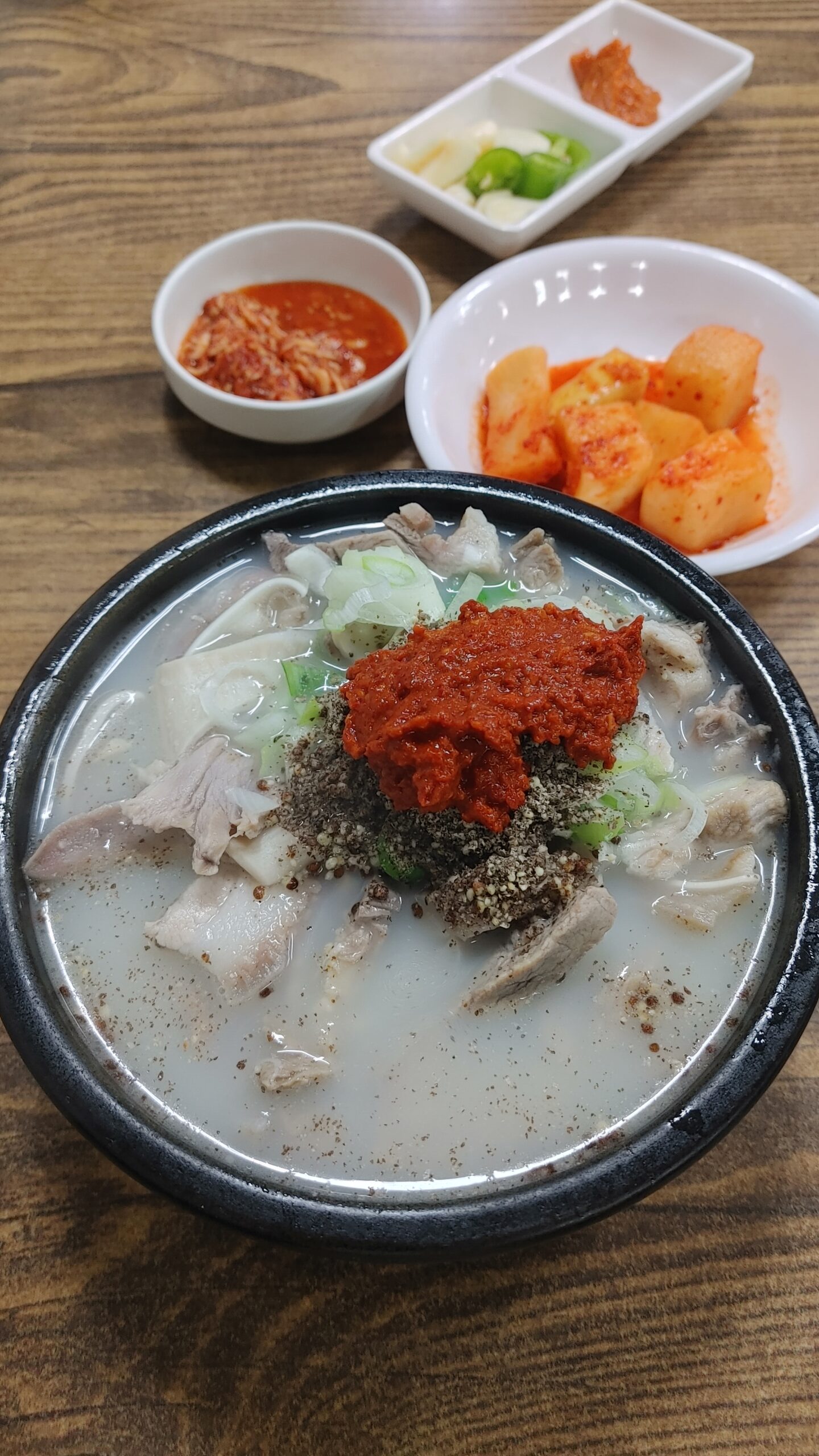
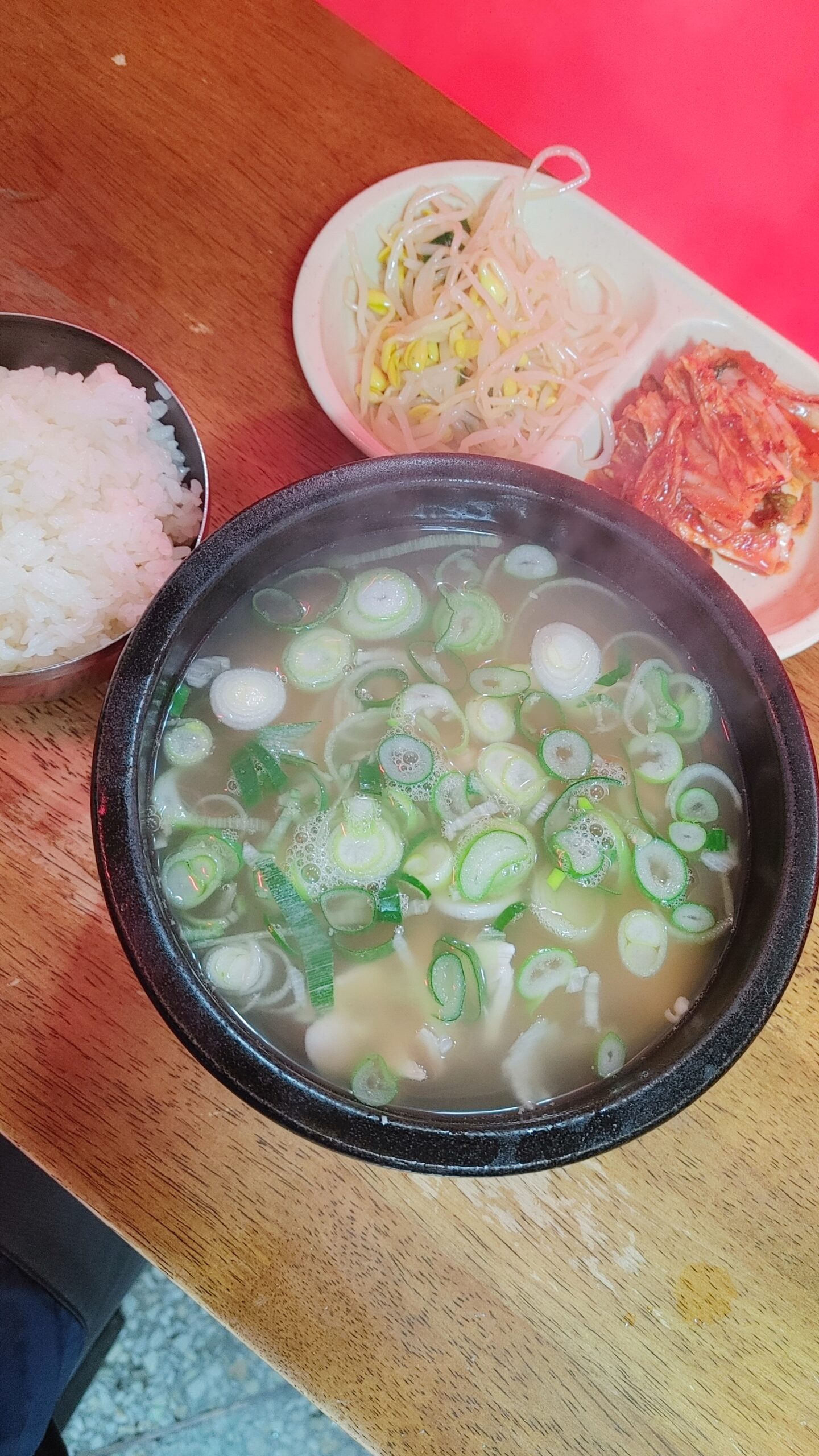
    My dinner at a Korean sundae soup restaurant
    My dinner at a Korean sundae soup restaurant

    American staple meals center on bread. Japan and Korea both center on rice. If Korean food has a reputation for being healthy, it may be because it still uses fewer ultra-processed ingredients than many Western diets, and portion sizes — at least historically — have tended to be more modest. (That said, times have changed: my eldest son is nearly 190cm tall and close to 90kg. Maybe all that fried chicken when he was young had something to do with it — just kidding.)

    The Real Secret: Fermentation and Microbes

    The foundation of all Korean food is fermentation.

    It wasn’t until I learned about microorganisms that I truly understood why I had always craved the deep, funky, complex flavors of Korean cuisine when I was away from home. The human body contains roughly 30 trillion human cells — but it also hosts about 100 trillion microorganisms, most of them living in the digestive tract. In purely numerical terms, the microbes outnumber us. They are, in a sense, the true residents of our bodies.

    And yet, I had never really listened to them before.

    The flavor that microorganisms create appeals not to the eyes, but to the nose and mouth — something primal, instinctive. And it’s not just taste; it’s the way your body responds after eating. Many cultures around the world intuitively reach for broths and fermented foods when they’re sick — vegetable soups, chicken broth — and Korean food has operated on this principle for centuries.

    Korea’s four distinct seasons and rich biodiversity have given rise to a deeply developed fermentation culture. Each region has its own traditional foods, many of which — as Korea faces rapid aging and rural depopulation — are at risk of disappearing. Documenting where these foods come from and what they look like today matters more than ever.

    The Scent That Tells the Story

    Understanding the past and present of a cuisine opens up ideas for where it can go next.

    What I find most compelling about Korean food is its distinctive aroma — the smell that comes from fermentation, from the microorganisms native to the Korean peninsula, from the land and sea that produce its ingredients, and from the accumulated wisdom of Korean mothers who have worked with these elements for generations. Follow that scent, and you’ll find the path Korean food is meant to travel.

    The True Makers of Korean Cuisine

    Ultimately, Korean food — like the traditional cuisines of any country — is the product of mothers cooking for their families, thinking about health, using what the land around them provides.

    Korea, like the US and Japan, has its major food conglomerates: Samyang, CJ CheilJedang, Nongshim, Lotte Chilsung, Ottogi, Daesang, SPC Samlip. But even so, Korean shopping baskets still tend to lean more heavily toward vegetables than toward meat and fish compared to Western counterparts.

    Regional Diversity: No Two Kitchens Are the Same

    Korean food carries a strong national identity — but within that identity lives extraordinary regional diversity. Every region has its own way of making ganjang, doenjang, and gochujang, with recipes and flavors that differ from household to household. Think of how maple syrup varies from region to region in the United States, and you’ll get the idea.

    KBS runs a long-running program called Koreans’ Dining Table (한국인의 밥상), which has aired over 745 episodes across more than a decade. What the show consistently reveals is that traditional Korean side dishes and regional foods don’t follow a fixed recipe — they follow a mother’s hand. The flavor depends on who is cooking.

    And maybe that’s exactly what makes Korean food special: it belongs to a category called “food,” but no two versions of it taste exactly the same.

    You Also like this

    what is korean babsang

    what is banchan?

    If U more know more korean food, refer our

  • What Is Baekban? Everything About Korea’s Traditional Everyday Meal

    What Is Baekban? Everything About Korea’s Traditional Everyday Meal

    When Korean office workers think about where to have a simple, satisfying lunch, most of them will immediately think of baekban.

    It would be hard to find anyone who disagrees. Baekban restaurants serve meals based on their own unique recipes — a variety of side dishes that taste just like home-cooked food. Nothing overly fancy, nothing too heavy, just honest, familiar food that warms the stomach.

    The reason baekban is so widely preferred is simple: the side dishes closely resemble what you would eat at home. Personally, I visit a baekban restaurant at least three times a week during my lunch break. It is that kind of place — reliable, comforting, and never tiring.

    A well-known baekban restaurant will typically offer gajeongsik baekban (home-style baekban), where the soup and side dishes change every single day. The side dishes rotate with the seasons, and some restaurants even adjust the menu based on the weather and temperature of that day. As you get older, you tend to gravitate away from flashy restaurant meals and toward the simple, nostalgic flavors that remind you of what your mother used to cook.


    1. The Meaning and Origin of Baekban

    What Baekban Originally Meant

    The word baekban (白飯) literally means “white rice.” Historically, it referred to a simple rice-centered meal table. In traditional Korean dining, the principle is hansang charrim — everything served on the table at once. The foundation is a bowl of steamed white rice, accompanied by soup, fermented pastes such as doenjang (soybean paste) or gochujang (red pepper paste), and a few side dishes. This is the baekban table in its most authentic form.

    The spirit of baekban is deeply rooted in restraint. Even during the Joseon dynasty, the royal table reflected this philosophy. When a drought came and a rain-prayer ceremony was held, the king would reduce the number of dishes on his own table — a meal known as soseon (素膳), or a plain, modest table. Meat dishes were set aside. Even tofu was sometimes removed. Baekban was not a meal of poverty — it was a meal of discipline.

    Baekban also varies by region. In coastal areas, jeotgal (fermented seafood) is a defining feature of the table. In winter, a well-fermented kimchi alongside steamed rice is enough to make a complete and satisfying meal. A famous example is Yokjaengi Halmeonim Jip (the “Scolding Grandmother’s Restaurant”) in Pocheon, Gyeonggi-do, known for its hearty siraegi doenjang-guk (dried radish greens soybean paste soup). Meat and tofu dishes are available as add-ons, but the soul of the meal is in its simplicity.


    2. The Components of Baekban

    The Basic Structure: Rice + Soup + Side Dishes

    Korean baekban rice meal with soup and side dishes - kimchi jiegae
    kimchi Jjigae (kimchi stew – 9000won, my dinner)

    The core of baekban is straightforward — steamed rice, soup (or jjigae), and a selection of side dishes. But within that simplicity lies the depth of Korean food culture.

    Depending on the restaurant, soup may come as a default, or the meal may be centered around a jjigae such as kimchi jjigae or doenjang jjigae. When a jjigae is ordered, a separate soup is usually not served, but the standard side dishes always come with the meal. What makes baekban special is that the side dish selection changes daily, entirely at the owner’s discretion — making every visit feel slightly different.

    How the Seasons Change Baekban

    One of the most distinctive qualities of baekban is that side dishes change with the seasons. From a restaurant owner’s perspective, sourcing seasonal ingredients keeps costs manageable while delivering better flavor. Seasonal vegetables are fresher, tastier, and less expensive — a win for everyone.

    • Spring: Shepherd’s purse (naengimuchim), wild chives (dallaemuchim), spring greens
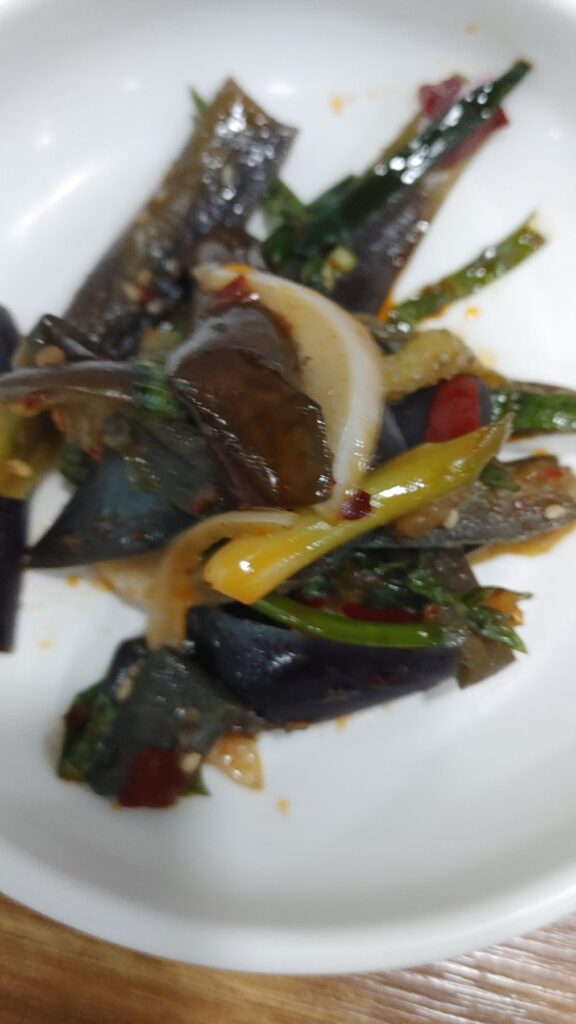
    • Summer: Cucumber salad, eggplant namul, yeolmu kimchi
    • Autumn: Mushroom stir-fry, sweet potato stem, radish salad
    • Winter: Burdock braised (ueongjjorim), blanched spinach, bean sprouts, cabbage and radish dishes

    This seasonal rhythm is felt more vividly in rural and regional baekban restaurants than in Seoul. Local restaurants tend to source directly from nearby farms, giving the side dishes a distinctly regional character.


    3. Types of Baekban

    Baekban vs Hanjeongsik — What Is the Difference?

    Many people confuse baekban with hanjeongsik, but the two are quite different in character, price, and occasion.

    BaekbanHanjeongsik
    CharacterCasual, home-style everyday mealRefined, course-style Korean cuisine
    CompositionRice, soup, jjigae, 3–5 side dishesGujeolpan, sinseollo, premium dishes
    Price (per person)Around 10,000 KRW20,000–50,000+ KRW
    OccasionDaily diningSpecial occasions, formal gatherings

    Hanjeongsik is short for “Korean food formal course meal.” The name changes depending on what the main dish is — galbi hanjeongsik (braised short ribs), gulbi hanjeongsik (dried yellow croaker), Nando hanjeongsik (Southern Korean style), or gungjoong-sik (royal court cuisine). Each region has developed its own version of hanjeongsik, driven by local specialties and ingredients.

    For context, hanjeongsik is typically reserved for milestone events — a sanggyeolle (formal family meeting before a wedding), a child’s first birthday (doljanchi), or important business dinners. Baekban, on the other hand, is simply Tuesday lunch.

    Gajeongsik Baekban — Home-Style Baekban

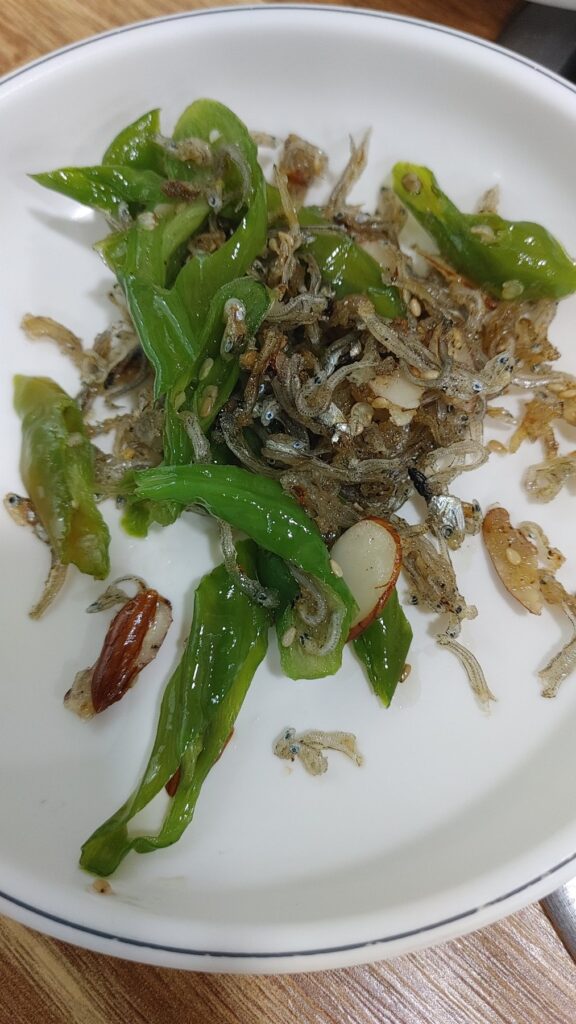
    Gajeongsik baekban is the type of baekban that most closely resembles a meal made at home. The side dishes are simple, easy to prepare, and deeply familiar — anchovy stir-fry (myeolchi-bokkeum), egg dishes, and various seasoned vegetables.

    There is also a quiet nutritional thoughtfulness behind gajeongsik baekban. Anchovy stir-fry is rich in calcium, beneficial for bone health. Eggs provide essential protein. Mothers who prepare baekban at home often select organic vegetables and free-range eggs, thinking carefully about what goes into each dish. The irony, of course, is that the child who grew up eating all of this will inevitably end up drinking cola at 20 — but that is a different story.


    4. Baekban, Nutrition, and Health

    Is Baekban Good for a Diet?

    Honestly, when someone asks whether baekban is good for weight loss, the answer is — relatively, yes. In a modern food environment full of fast food, fried chicken, pizza, sugary drinks, and processed snacks, baekban sits at the opposite end of the spectrum.

    A bowl of rice in a baekban meal is roughly equivalent in calories to two slices of white bread. The side dishes are made from whole, natural ingredients — not heavily processed or refined. Meat dishes do appear in baekban, but the portion is modest. The majority of the plate consists of vegetables, fermented foods, and grains.

    Many young Koreans today skip a proper lunch and instead consume high-sugar coffee drinks, pastries, or snacks. Compared to that kind of meal pattern, a full baekban set — with its variety of ingredients and balanced nutritional profile — is far better for long-term health and weight management. It is not a flashy diet food, but it is quietly one of the healthiest options available for an everyday meal.


    5. How to Find and Use a Good Baekban Restaurant

    Finding the Best Baekban Restaurant

    The easiest and most reliable way to find a good baekban restaurant is to check Google Maps ratings and reviews. If you are visiting Korea as a foreigner, this is especially useful because reviews are written by actual visitors and often include photos and pricing.

    Search tip: Instead of searching only “baekban,” also try “hanjeongsik” or “jeongsiк” — you will get a wider range of results, including highly-rated options nearby. The key is to read the reviews carefully and look at the photos to understand what kind of food is being served.

    Practical Tips for First-Time Visitors

    Check the price on the wall: Every baekban restaurant displays its menu and prices on the wall. It will be in Korean, but the owner will happily explain if you ask.

    Refills are often available: Side dishes can be left unfinished — there is no pressure to eat everything. If you particularly enjoy one of the side dishes and finish it, ask for a refill. Most baekban restaurants will refill side dishes either for free or for a small charge.

    Extra rice: If you finish your rice and want more, ask for an extra bowl of rice (gongibap). It typically costs around 1,000 KRW, though this varies by restaurant.

    Dining with young children: If you are visiting with a child aged 7 or under, it is perfectly acceptable to ask whether ordering for two adults is fine. If you feel more comfortable ordering three portions, take the opportunity to try different menu items — you do not have to order the same dish three times. For children, gyeran-mali (Korean rolled omelette) is a great choice if the restaurant has it on the menu.

    Average Price Range

    • Regional cities: 8,000–9,000 KRW per person
    • Seoul and Gyeonggi area: 10,000–15,000 KRW per person
    • Hanjeongsik: 20,000–50,000+ KRW per person

    As a general rule, higher price means more side dishes and higher-quality ingredients.


    FAQ

    Q. How much does a baekban meal cost?

    Typically around 10,000 KRW per person. In regional cities, you can find it for 8,000–9,000 KRW. In Seoul and the surrounding Gyeonggi area, expect to pay 10,000–15,000 KRW. More expensive sets come with more side dishes.

    Q. What is the difference between baekban and jeongsiк?

    Baekban is a casual, home-style rice meal. Jeongsik (or hanjeongsik) is a more structured, course-style meal with premium ingredients and a refined presentation. Think of baekban as everyday comfort food, and jeongsik as a meal for special occasions.

    Q. Why is baekban recommended for foreign visitors?

    Because a single baekban meal introduces you to a wide variety of Korean ingredients and cooking methods all at once. Moreover, the flavor and style of baekban changes depending on where in Korea the restaurant owner is from — a chef from Jeolla-do will serve something quite different from one raised in Gyeongsang-do or Jeju. Each table tells a regional story.


    Why Koreans Love Baekban?

    Eating baekban brings back memories of home — of the town where you grew up and the meals your mother made. It does not overwhelm you. It does not tire you. You can eat it every day and never feel like it is too much.

    For modern Koreans exhausted by food that is too salty, too sweet, too greasy, or too processed, baekban offers something rare: a meal that simply comforts. It asks nothing of you. It just feeds you well.

    If you are ever traveling through Korea’s regions, make a point of trying the local hanjeongsik at least once. And if you find yourself in Jeolla-do (South Jeolla Province), be prepared to be genuinely surprised — the number of side dishes placed on your table will likely be unlike anything you have experienced before. Baekban at its finest is not just a meal. It is a small act of care, passed from one table to the next.

    Jungsik vs Baekban

    hanjungsik-A set meal at a formal restaurant in front of the restaurant. At upscale restaurants, the price can be two to five times higher. A set meal typically includes rice, soup, a main dish, and at least six side dishes. (This my lunch price is 10000won, about $9)
    Korean baekban rice meal with soup and side dishes - kimchi jiegae
    Baekban (Korean rice) typically consists of rice, soup, and about six side dishes. Of course, the number of side dishes and soup may vary from restaurant to restaurant. It may even be less. The typical price is 10,000 won, or $9.

    You need more interest – What is Banchan? and What is hanjeongsik?

  • Guk vs Tang vs Jjigae vs Jeongol: Complete Guide to Korean Soups

    Guk vs Tang vs Jjigae vs Jeongol: Complete Guide to Korean Soups

    Introduction

    Korean dining tables always feature certain beloved menu items. Throughout spring, summer, fall, and winter, Koreans prepare guk (soup), tang (rich broth), jjigae (stew), and jeongol (hot pot) using seasonal ingredients appropriate for each time of year.

    What is Guk (국)?

    The dictionary definition of ‘guk’ is a dish made by adding a large amount of water to meat, fish, or vegetables and boiling them. If we had to specify the ratio of water to ingredients, it would be roughly 6:4 or 7:3.

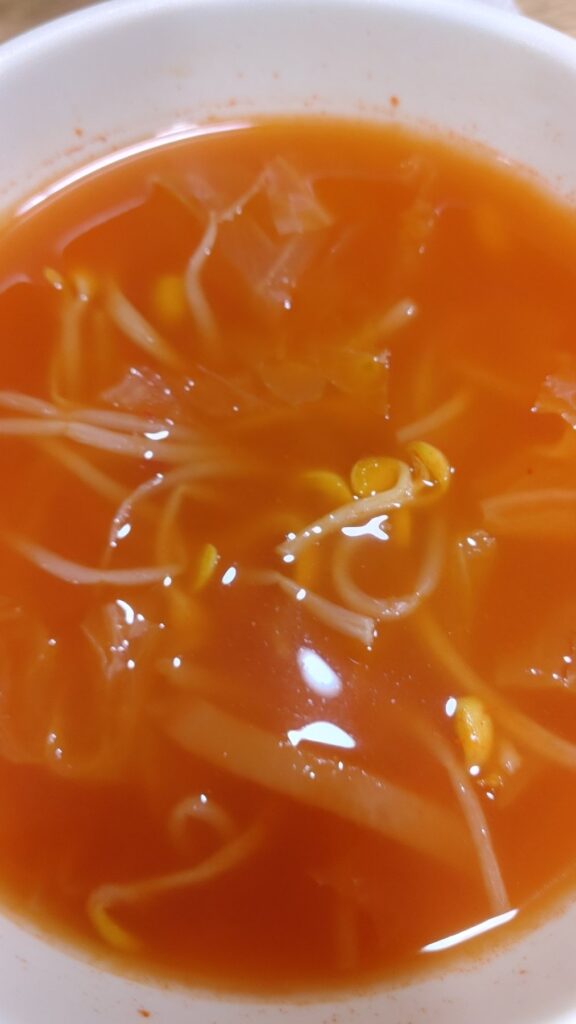
    Guk is frequently prepared for every meal, and its cooking time is much shorter compared to jjigae or tang. In my home, at baekban (Korean set meal) restaurants, and during Korean office lunch hours, various types of guk are prepared at each establishment: egg soup (gyeran-guk), dried pollack soup (bugeo-guk), seaweed soup (miyeok-guk), bean sprout soup (kongnamul-guk), beef radish soup (sogogimu-guk), dried napa cabbage soup (ugeoji-guk, which uses dried vegetables and adds doenjang for seasoning), soybean paste soup (doenjang-guk), and radish soup (mu-guk, which I frequently eat during cold winters).

    Another important thing to know is that the ingredients for these soups are somewhat less expensive compared to tang or jjigae, and they’re made using seasonal vegetables. For bugeo-guk and miyeok-guk, dried seaweed and dried pollack (called bugeo) have excellent storage qualities. Compared to other jjigae or tang dishes, the ingredient preparation and handling are simpler, making them more convenient to prepare and eat at home.

    Back in the 1990s when my mother used to cook, doenjang-guk (soybean paste soup) was very common. There was much less food available than now, and fewer imported agricultural products as well. At that time, lifestyle diseases and obesity were quite rare. Now, as a parent raising children myself, when I talk with my family about it, we realize that the foods our family ate back then had extremely few ultra-processed foods compared to now, and there were virtually no genetically modified foods. To create flavor in those days, most seasonings like doenjang (soybean paste), gochujang (chili paste), salt, and soy sauce were made at home, and there weren’t many chemical additives used to artificially enhance taste.

    What is Jjigae (찌개)?

    According to Korean dictionaries, jjigae is first defined as a side dish made with less broth (less water added compared to guk or tang), cooked with tofu or vegetables, gochujang (chili paste), or doenjang (soybean paste), seasoned and slightly salty. Of course, restaurants sell menu items like doenjang-jjigae (soybean paste stew) and gochujang-jjigae (chili paste stew). They’re generally served as part of a baekban (set meal). If you order doenjang-jjigae baekban, you get doenjang-jjigae, and if you order jeyuk-baekban, you get jeyuk (stir-fried seasoned pork) along with various side dishes.

    Jjigae generally has strong seasoning, making it perfect for mixing with rice or pairing with rice – they’re an ideal match. It’s commonly eaten together with rice, and the most popular jjigae menu items include kimchi-jjigae (kimchi stew), doenjang-jjigae (soybean paste stew), dubu-jjigae (tofu stew), jogi-jjigae (yellow croaker stew, mainly eaten by coastal residents), sundubu-jjigae (soft tofu stew), and haemul-doenjang-jjigae (seafood soybean paste stew) – the varieties are diverse.

    When I have time someday, I plan to visit and introduce a jjigae restaurant located near Hongdae Station.

    Fourth Category: Jeongol (전골)

    If we compare jeongol to foreign examples, it’s similar to shabu-shabu. In China’s case, it’s also similar to malatang. The cooking method involves each home or restaurant preparing their own broth separately, then during cooking, adding various vegetables and meat to the broth and boiling it. When jeongol is served during a meal, it’s positioned in the center of the dining table. Multiple people sit around it and use ladles to scoop small portions onto their individual plates.

    When I was young, jeongol didn’t exist, but nowadays people eat jeongol frequently. The main season for eating it is during winter when you crave warm broth.

    The names of jeongol dishes are diverse. They vary greatly depending on the ingredients used: haemul jeongol (seafood hot pot), gopchang jeongol (intestine hot pot), beoseot jeongol (mushroom hot pot), bulgogi jeongol (marinated beef hot pot), mandu jeongol (dumpling hot pot), shabu-shabu, and so on. For example, in the case of gopchang jeongol, since the main ingredient is gopchang (intestines), it’s named gopchang jeongol.

    When Visiting Restaurants in Korea…

    Generally, guk is provided as a basic side dish with every meal. And of course, refills are available. The type of guk varies depending on what food each restaurant serves. In Korean restaurants that serve spicy food, in a way, kongnamul-guk (bean sprout soup) or miyeok-guk (seaweed soup) may be served to soothe the spicy taste.

    If you’re eating samgyeopsal (pork belly) or galbi (ribs), doenjang-guk (soybean paste soup) or kongnamul-guk (bean sprout soup) may be served accordingly. In winter, most soups provided by restaurants are served warm.

    What Are the Key Differences?

    12’clock – Seollangtang and beef hangover soup vs 6 o’clock Haejangguk (with my son)

    The first difference is cooking time. Jjigae and guk have shorter cooking times compared to tang. For example, gomtang or galbi-tang are cooked over low heat for a minimum of 1 hour to as much as 12 hours to tenderize the meat. This is to extract the broth from inside the rib bones.

    If you visit Korea, you should definitely try galbi-tang or gomtang. They’re available near Hongdae too, and the price is around $10. If you want to try something more unique at that time, I recommend trying suyuk. Suyuk is meat that has been boiled for a long time until tender, then sliced thin and served.

    Sugar Free Options?

    Guk dishes that don’t contain sugar or syrup include bugeo-guk (dried pollack soup), kongnamul-guk (bean sprout soup), doenjang-guk (soybean paste soup), mu-guk (radish soup), siraegi-guk (dried radish greens soup), baechu-guk (napa cabbage soup), and miyeok-guk (seaweed soup). This is because Korean cooking methods for these dishes don’t use sugar (just as my mother did). An interesting fact is that these soups are also GMO-free.

    My wife adds about a teaspoon of sugar to kimchi-guk, but if I were to make kimchi-guk, I wouldn’t add sugar. I don’t like that slightly sticky, clinging feeling on the tongue that comes from foods with sugar.

    And most tang dishes don’t use sugar either. I was born in Andong, Korea, and people in Andong don’t particularly like sweet foods. Even now, when preparing meals for my children, I absolutely don’t use sugar when cooking. (I wonder if my children understand their father’s heart – that since they’ll eat ice cream and snacks outside anyway, they should eat a little less of it at home?)

    Tang dishes that don’t contain sugar include gomtang, galbi-tang, and so-galbi-tang. You can tell as soon as you taste them. And in traditional Korean cooking methods passed down through generations, these tang dishes don’t use sugar.

    Haemul jeongol (seafood hot pot), gopchang jeongol (intestine hot pot), beoseot jeongol (mushroom hot pot), bulgogi jeongol (marinated beef hot pot), mandu jeongol (dumpling hot pot), and shabu-shabu contain small amounts of sugar because they need to be a bit sweet. However, I can’t really compare the taste between American maple syrup and sugar, but perhaps maple syrup, being sweetness extracted from trees, is a bit healthier? In Korea too, there’s an increasing trend of using organic sugar rather than white sugar. There’s a perception that unrefined sugar is healthier than refined sugar.

    One Thing Korean Mothers Always Consider When Preparing Meals

    My father and the elderly generation said they wouldn’t eat rice without guk. It’s convenient to eat, and back in the day, due to Korea’s ‘ppalli ppalli’ (hurry hurry) culture, people didn’t even talk during meal times – they just ate their rice. Guk is convenient to prepare, and once you get the hang of it, you can prepare guk within 30 minutes. That’s why even a simple guk is prepared for meal times.

    Once guk is prepared, it’s not finished in one meal – if it’s eaten in the morning, enough is prepared to be eaten twice, including dinner. It reduces meal preparation time and also reduces ingredient costs, making it a food that embodies frugality.

    Conclusion

    Cooking time increases in this order: Guk > Jjigae > Jeongol > Tang

    Seasoning intensity decreases in this order: Jjigae and Jeongol > Tang > Guk

    At every meal, guk and tang are served in individual bowls, while jjigae and jeongol are placed in large pots in the center of the table, and people serve themselves from them. Guk and tang are not served this way – mothers prepare one bowl for each family member.

    How About this Article – What is Tank / Is Korean food Healthy?

    Q1: What’s the difference between guk and tang?

    A: Tang is an honorific form of guk (soup). Tang requires longer cooking time and more expensive ingredients than guk. Guk has a 6:4 or 7:3 ratio of water to ingredients and can be prepared within 30 minutes. Tang, however, is simmered over low heat for 1-12 hours to extract deep, rich broth flavors from bones.

    Q2: Which Korean soups don’t contain sugar?

    A: Most traditional soups, such as dried pollack soup, bean sprout soup, soybean paste soup, radish soup, dried radish soup, and seaweed soup, don’t use sugar. Among soups, gomtang (beef bone soup), galbitang (short rib soup), and sogalbitang (beef rib soup) are made without sugar. These dishes are GMO-free and are representative examples of healthy Korean cuisine.

  • Jeyuk Bokkeum Hanjeongsik – 8 GMO-Free Korean Sides in 15 Minutes

    Jeyuk Bokkeum Hanjeongsik – 8 GMO-Free Korean Sides in 15 Minutes

    A Warm Meal to Start the Day in Cold Winter

    The winter weather that has persisted since last year has been quite cold. With temperatures dropping below -10°C in winter and rising above 30°C in summer, the foods we eat vary significantly by season. Today, I’m having lunch with a friend and colleague.

    Today’s menu is hanjeongsik. We’re going back to the same place we visited yesterday.

    The Charm of Hanjeongsik – Daily Changing Side Dishes and Menus

    Today’s Menu

    Most hanjeongsik restaurants prepare different side dishes each day. Of course, the main dishes are also configured differently. This is a major advantage of choosing hanjeongsik. For Korean office workers, there’s no need to worry about the menu or side dishes, and you don’t have to worry about what your boss thinks either.

    GMO-Free Side Dishes – A Healthy Table Made with Korean Produce

    Today’s hanjeongsik featured GMO-FREE side dishes. Most of the side dishes are made primarily from namul (seasoned vegetables). This is because Korean-grown agricultural products and vegetables are relatively affordable in Korea’s climate.

    Today’s Hanjeongsik Composition

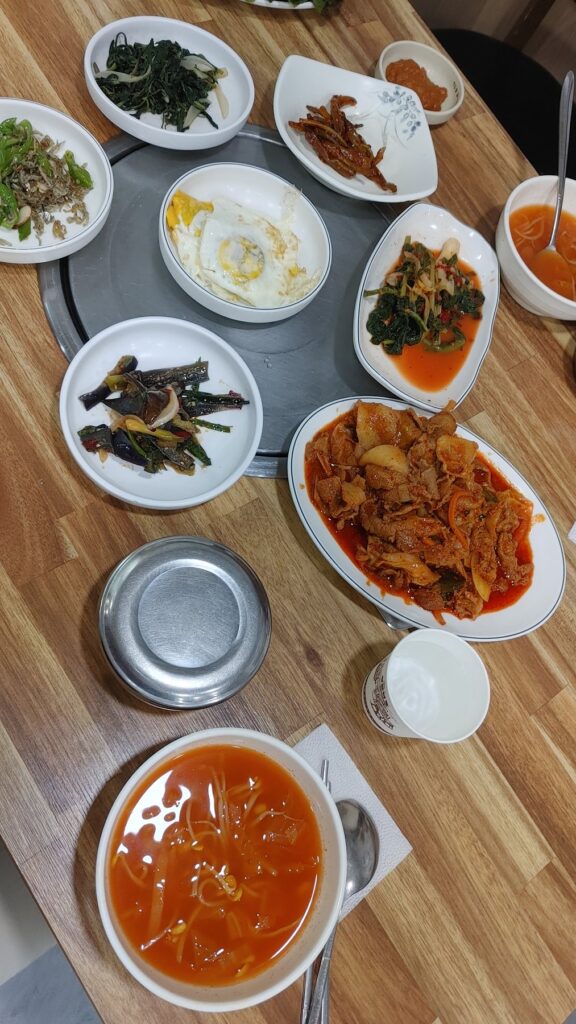
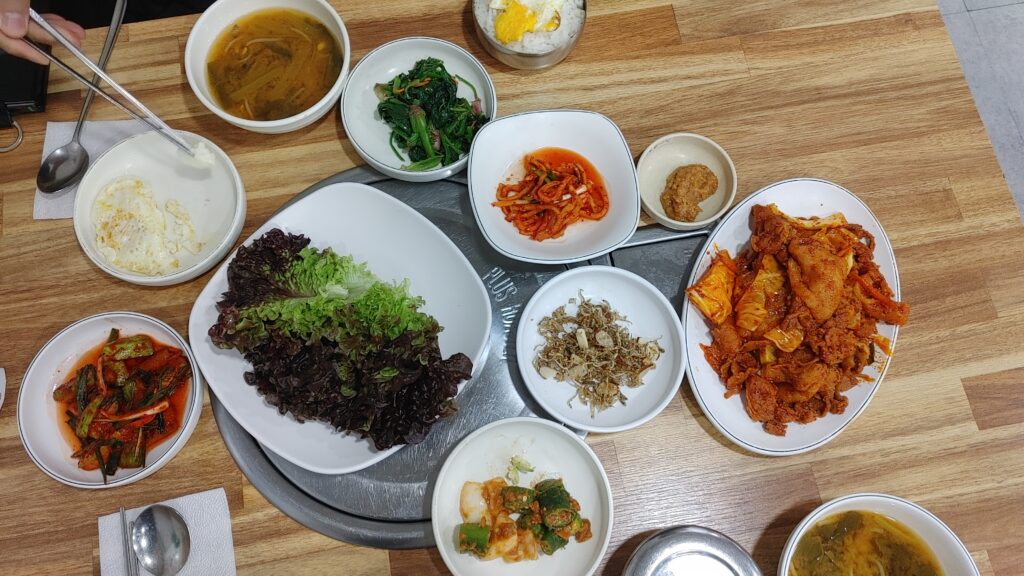
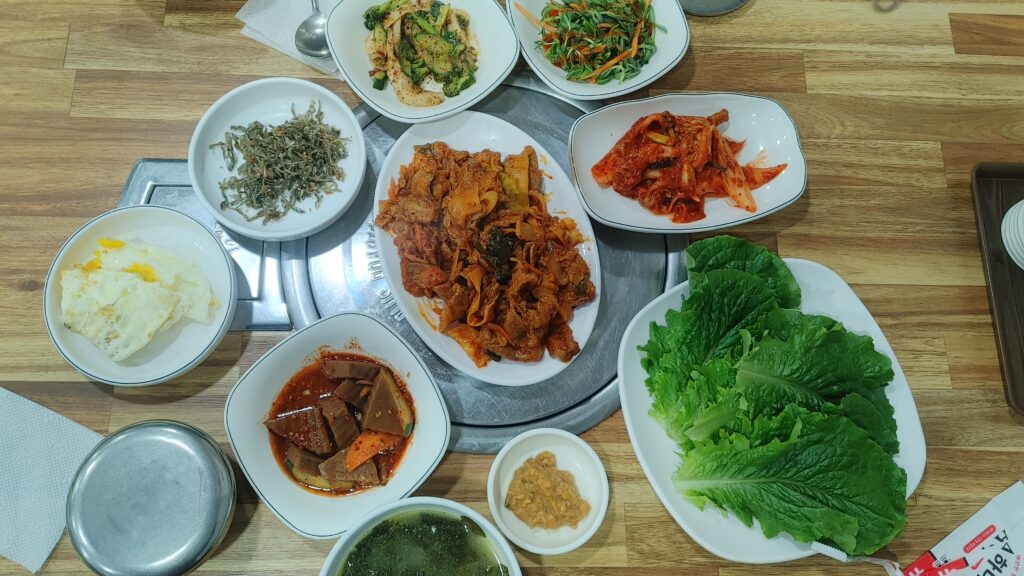
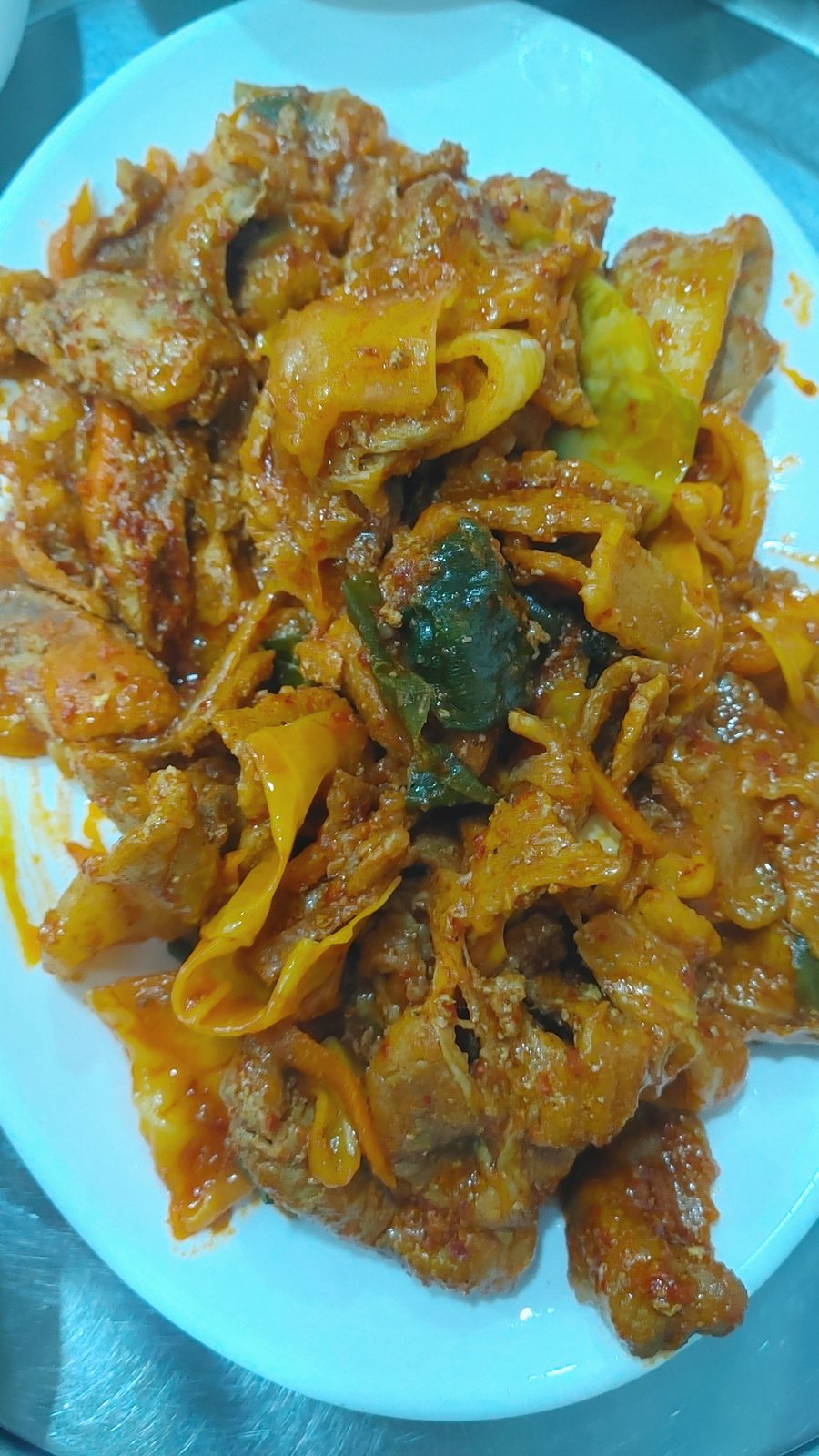
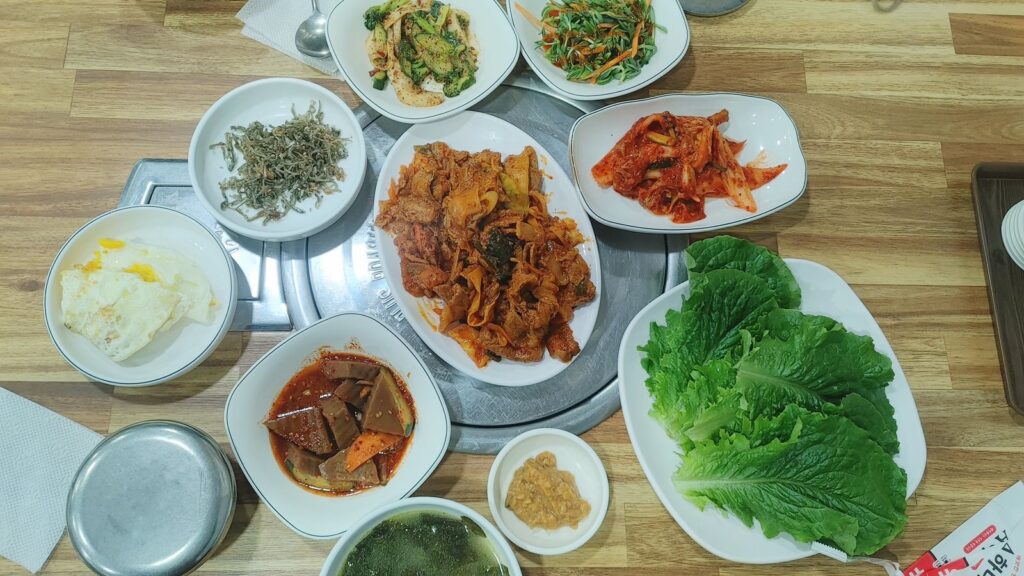
    Korean hanjeongsik table with jeyuk bokkeum and 8 GMO-free side dishes
    Jeyuk Bokkeum Hanjeongsik004-20260206

    🏷️ Menu List for tastyKoreanfood.com

    한글 메뉴명한글 발음 (Romanization)(English Name)
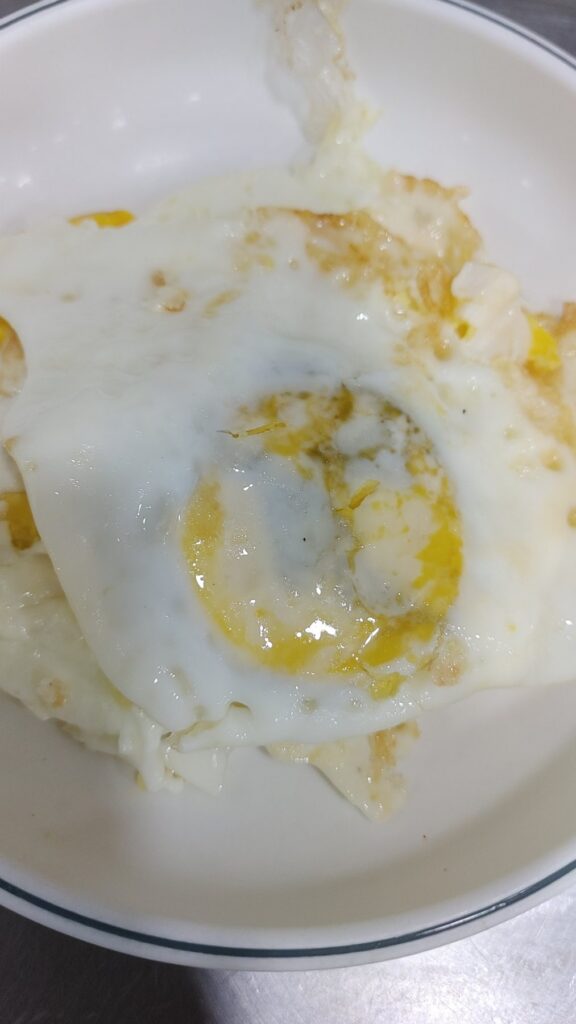
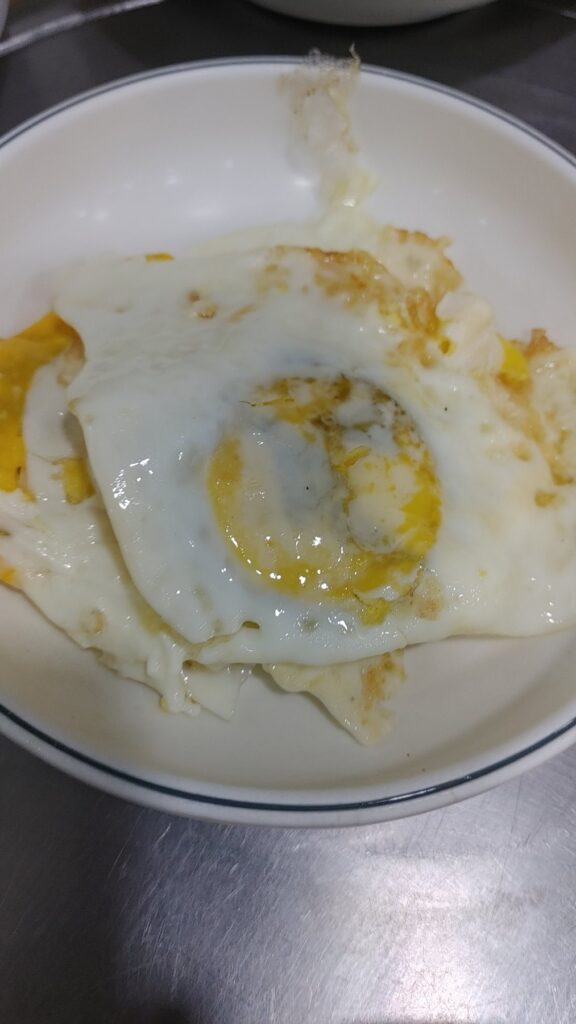
    계란후라이Gyeran-huraiFried Egg
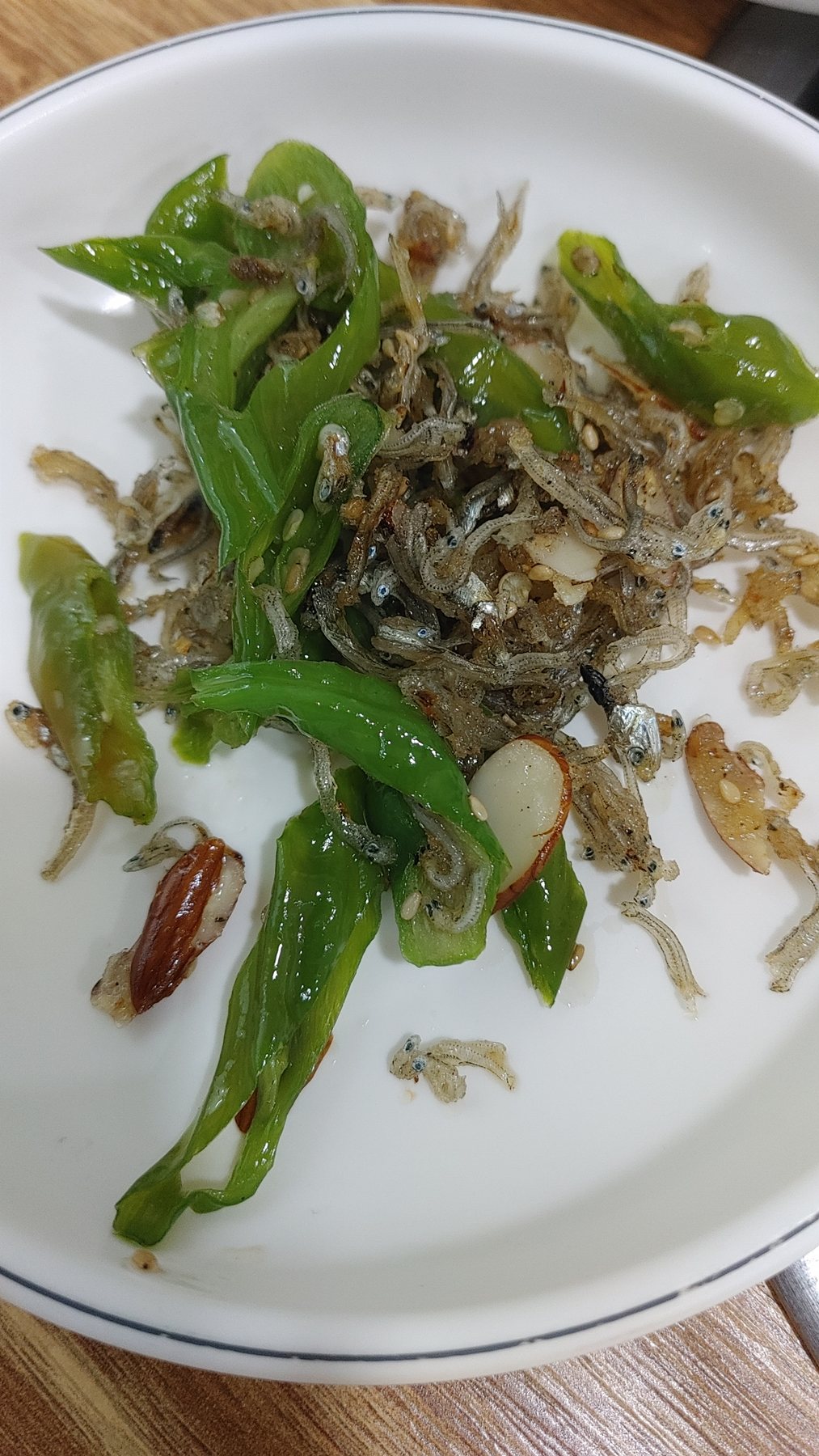
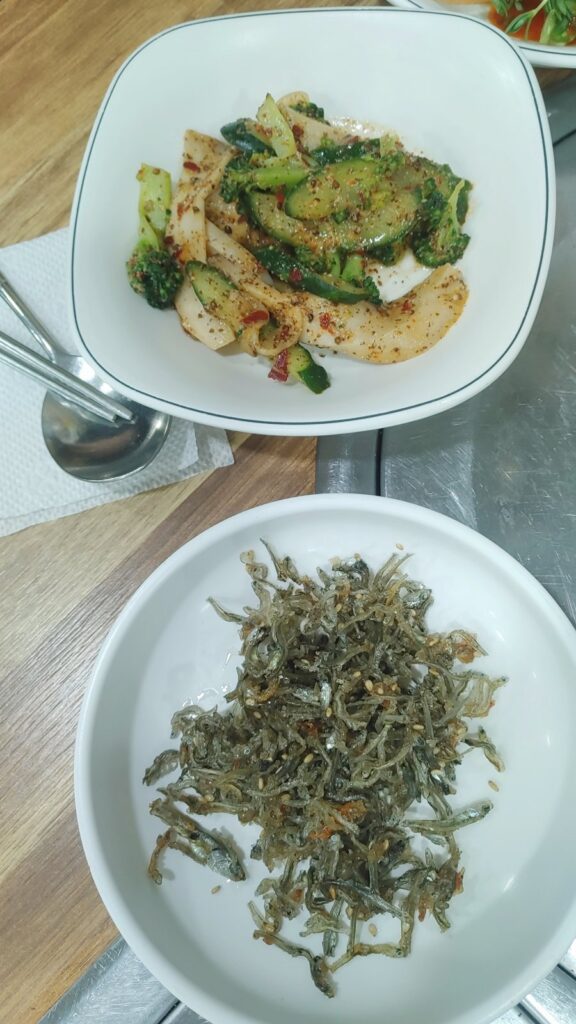
    멸치볶음Myeolchi-bokkeumStir-fried Anchovies
    오이무침Oi-muchimSpicy Cucumber Salad
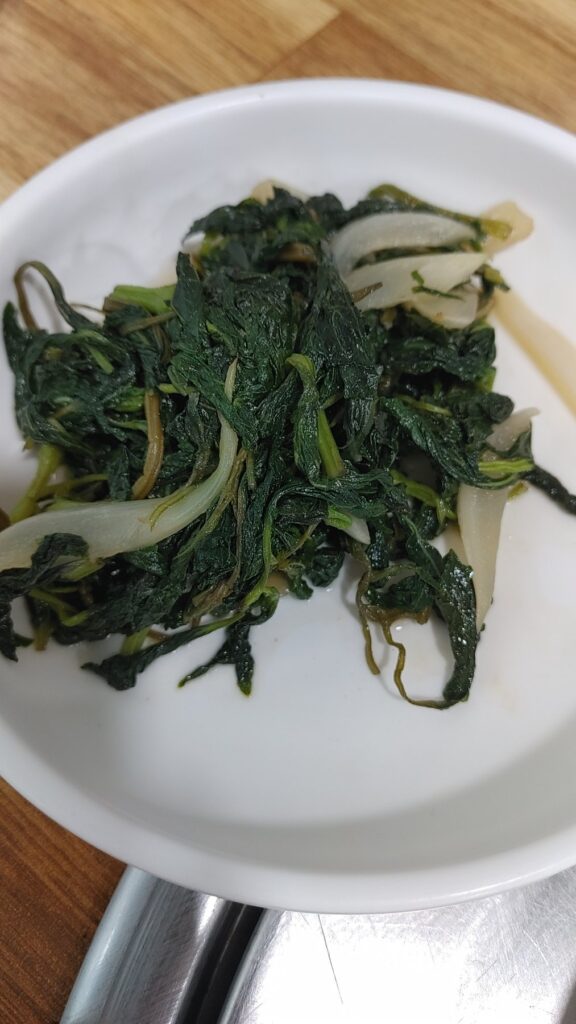
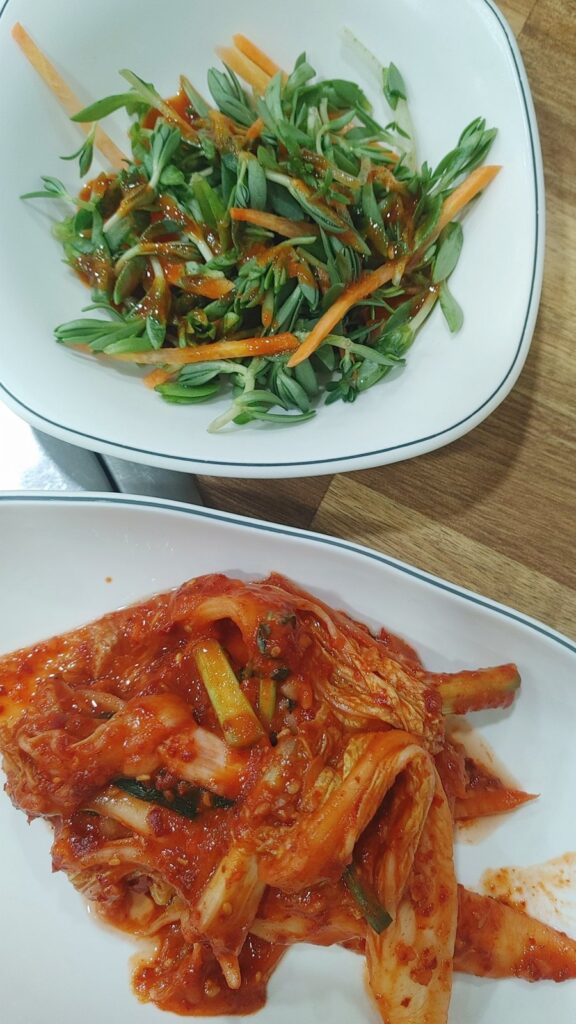
    돌나물무침Dolnamul-muchimSeasoned Sedum (Stonecrop)
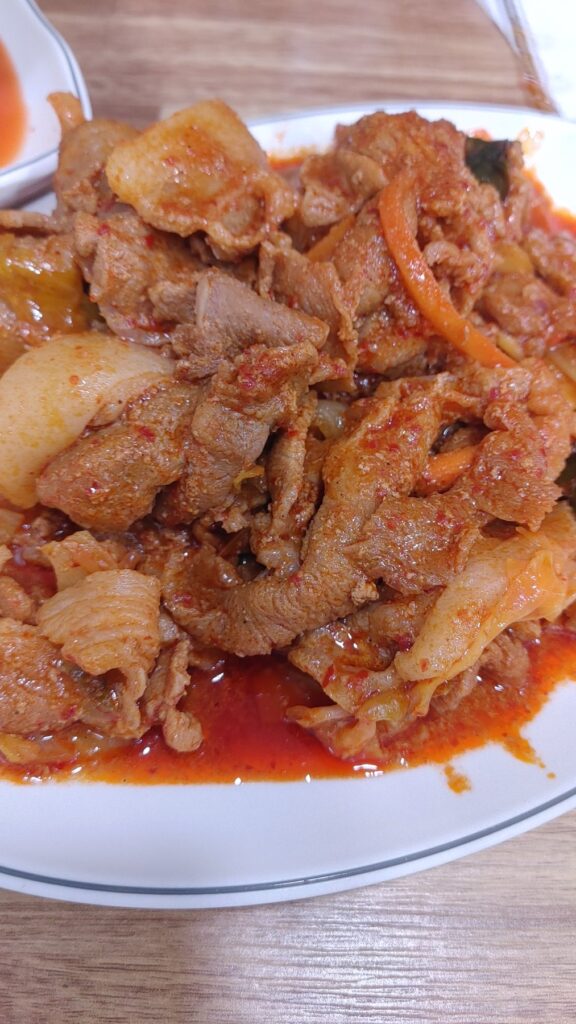
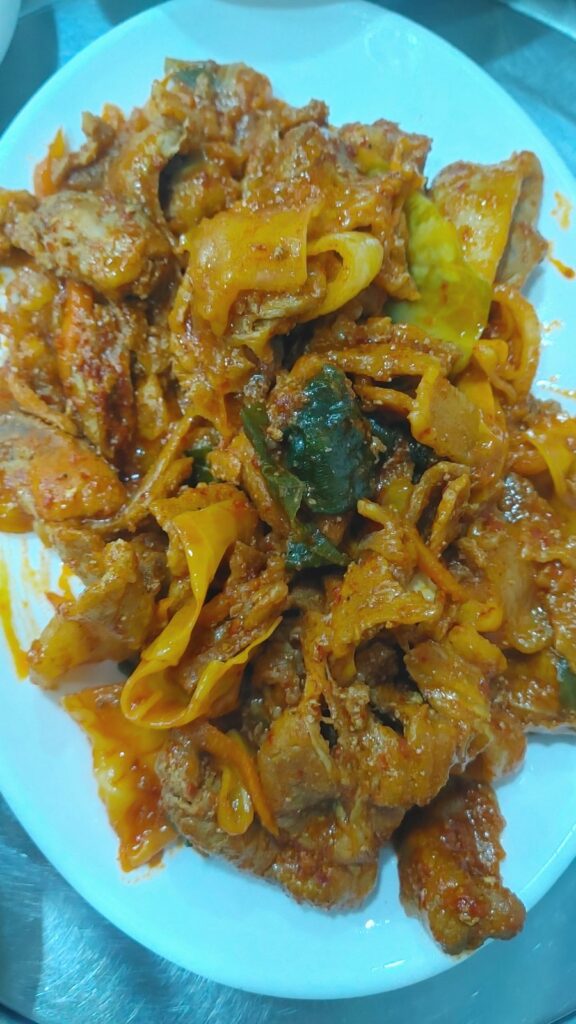
    제육볶음Jeyuk-bokkeumSpicy Stir-fried Pork
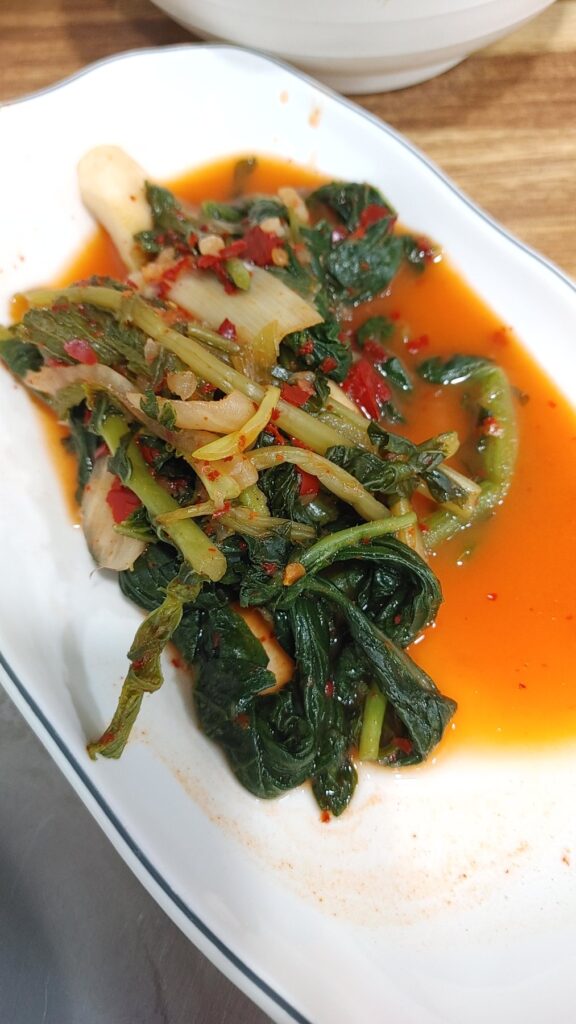
    김치KimchiKimchi
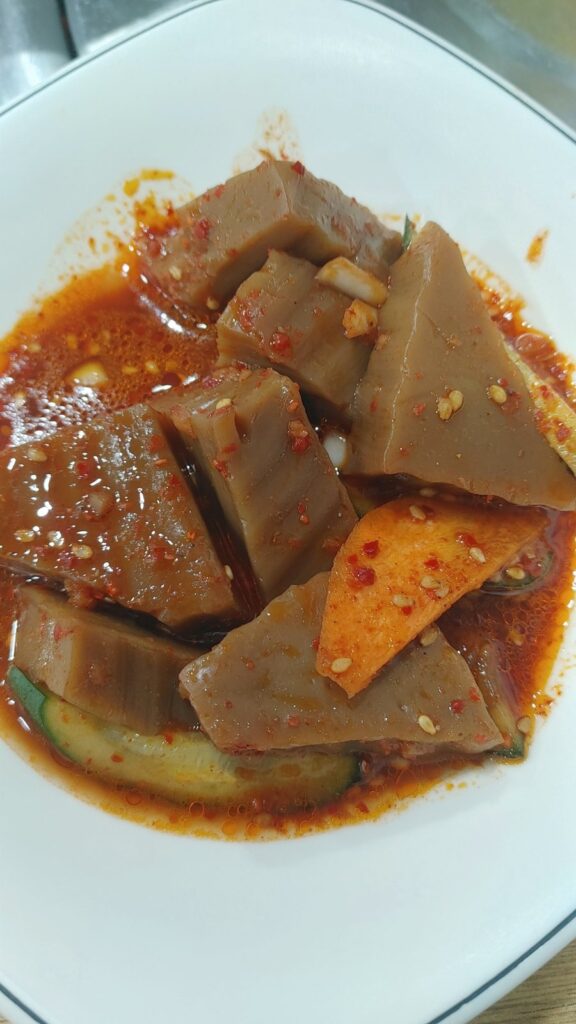
    도토리묵 무침Dotori-muk-muchimAcorn Jelly Salad
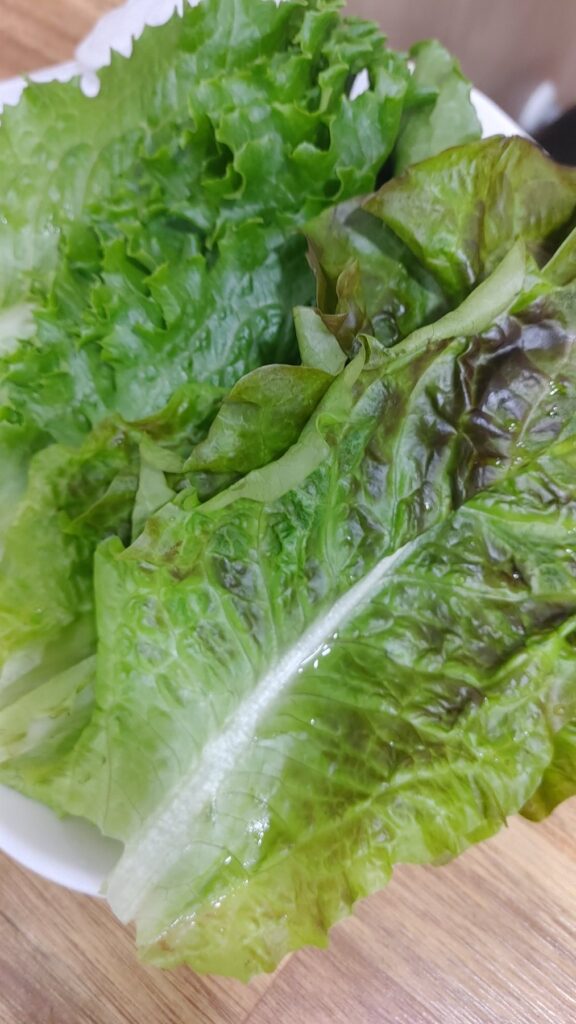
    상추SangchuLettuce
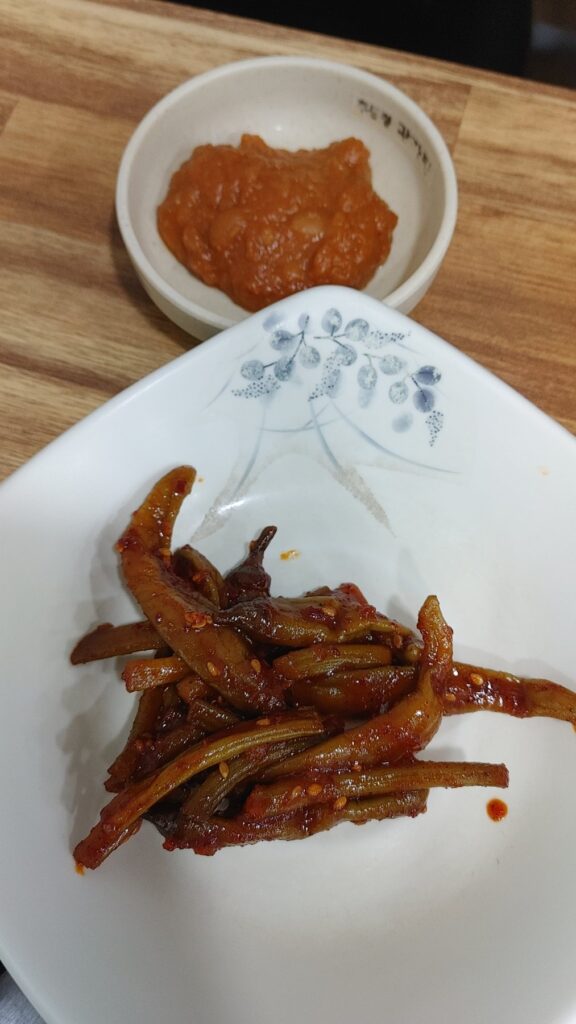
    쌈장SsamjangSsamjang (Seasoned Soybean Paste)
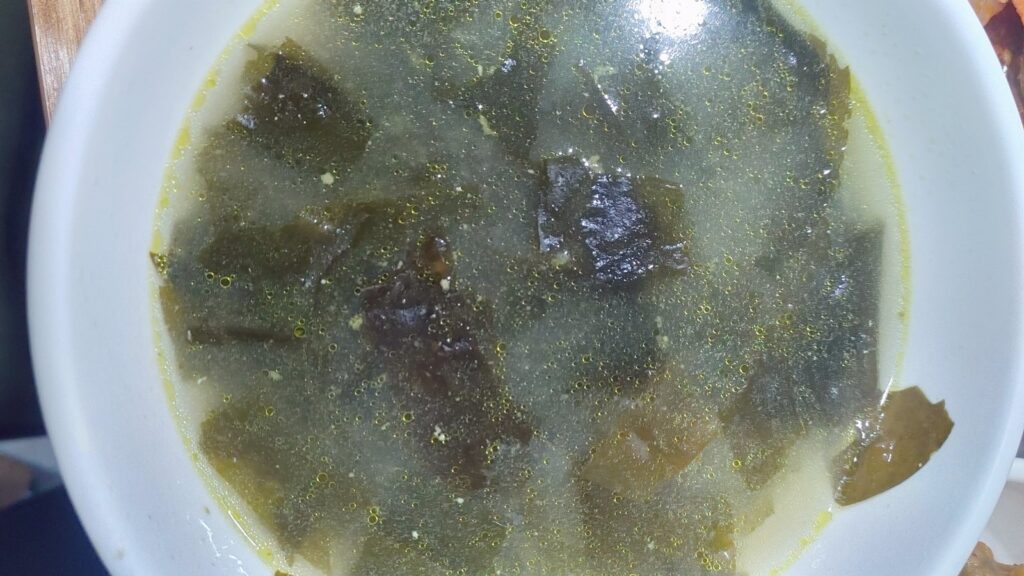
    미역국Miyeok-gukSeaweed Soup

    The main dish was jeyuk bokkeum (spicy stir-fried pork), accompanied by fresh vegetables for wrapping (ssam) and doenjang (fermented soybean paste). The soup was comforting miyeok-guk (seaweed soup), along with acorn jelly (dotori-muk), kimchi, freshly made kimchi, stir-fried mushrooms, fried egg, and anchovies. There was one side dish whose name I can’t quite remember… oh yes, dolnamul—young shoots of a succulent plant seasoned with red pepper powder and various seasonings.

    In total, there were 8 side dishes, miyeok-guk, and jeyuk bokkeum, making 10 items altogether. Looking at the composition of the side dishes and meal, most are made with Korean ingredients.

    Miyeok-guk – Korea’s Traditional Health Food for New Mothers

    Traditional Korean miyeok-guk (seaweed soup) for postpartum mothers, comparing wild vs farmed seaweed
    Miyeok-guk

    Miyeok-guk has always appeared in the diet of new mothers after childbirth.

    To introduce miyeok-guk: it’s a soup made primarily with miyeok (seaweed). Miyeok is an annual brown algae mainly consumed in Korea and Japan. In Korea, new mothers who have just given birth always seek it out. Eating miyeok-guk is said to promote breast milk production for the baby, and because seaweed has alkaline properties, it’s believed to be excellent for detoxifying the body.

    When my wife gave birth to our first and second children, she ate miyeok for almost a month. This custom of eating miyeok-guk dates back to ancient times. When a baby was born, the maternal family would visit their daughter with the best quality miyeok they could prepare.

    Wild Seaweed (Dol-miyeok) vs Farmed Seaweed – What’s the Difference?

    In Korea, the most preferred and highest quality seaweed is dol-miyeok (stone seaweed), which refers to naturally harvested seaweed collected from rocks.

    There’s also farmed miyeok, which is cultivated directly in the ocean. Compared to dol-miyeok, farmed seaweed has a thinner texture. However, dol-miyeok requires longer cooking time, but offers a richer, more flavorful taste.

    The Essence of Korean Food I Prefer – ‘Minimally Processed Food’

    I’m not from a generation that grew up eating donkatsu (Japanese-style pork cutlet). I’m approaching 50 years old now. So I don’t prefer donkatsu, and I frequently encountered what I call ‘rough foods’ that my mother made for me.

    ‘Rough food’ refers to dishes made from pure, unprocessed ingredients as they are. Nowadays, there’s what’s called ultra-processed food—finely textured foods that are widely distributed. But when I was young, I encountered many foods made with minimally processed ingredients like these. Even now, when choosing a restaurant with family or work colleagues, I tend to prefer rough, minimally processed foods whenever possible.

    Why I Don’t Spend My Own Money on Donkatsu?

    Everyone has their own constitution. My body reacts to fried foods. I experience poor digestion or stomach discomfort after eating them. That’s why I avoid fried foods as much as possible. I’m 52 years old now, after all.

    However, I do prefer foods cooked with pork fat or beef fat. According to data released by the FDA in 2026, animal fats are healthier than factory-produced seed oils made from plant seeds. Furthermore, they stated that consuming fermented butter or pure butter is healthier. So these days, although it’s not traditional Korean food, I eat fermented pure butter on my table for health reasons. (When I was young, I used to eat margarine.)

    Lunch Culture in Yeouido Financial District – Fast and Efficient

    At 11:30 AM, restaurants start getting crowded with customers coming for lunch.

    Yeouido, where I work, is full of office workers. Yeouido is Korea’s financial district, home to securities firms, banks, and financial industry professionals. Think of it as Korea’s Wall Street.

    Because most people commute early in the morning, lunch time for financial district workers starts as early as 11:00 AM for reservations, with crowds flooding restaurants from 11:30 AM onwards. Therefore, going early, eating quickly, and leaving is considered a virtue.

    What I mean is, when I eat with colleagues at a restaurant, I usually don’t exceed 15 minutes. The restaurants crowded here also do their main business during the lunch rush, so diners generally don’t sit for extended periods. In other words, meal times range from 15 to 25 minutes at most.

    Slightly more expensive restaurants offer separate rooms for dining. It seems to be the mindset of office workers to finish their meal quickly and rest a bit.

    Of course, if you visit a restaurant, you don’t have to finish your meal in 15 minutes. You can eat at a more leisurely pace. It’s just that Korea has this ‘ppalli-ppalli’ (quickly-quickly) mentality.

    Conclusion – Memories and Traditions in Korean Dining

    At Korean baekban (home-style meal) or hanjeongsik restaurants, the side dishes change almost daily. And most of these side dishes are the same ones my father and mother made for me when I was young, carried down to this day. So when I see these side dishes and foods, they bring back old memories.

    • GMO 검역 정보 → 식품의약품안전처

    • 미역의 영양 성분 → 국가표준식품성분표 DB

    • FDA 2026 발표 자료 → www.fda.gov (seed oils vs animal fats)

    • Korean food culture→ 한식진흥원


    What Is Banchan?

    In Korean meals, side dishes are not extras but an essential part of the table, which explains why banchan matters so much.

    Why Rice Is the Foundation of Korean Meals

    Even during a busy workday, Koreans still try to keep meals balanced, which is why rice remains the foundation of Korean meals.

    Why Soup Is Served in Most Korean Meals

    Soup is always placed next to rice, showing why soup is served in most Korean meals, even at lunch.

  • Korean Office Lunch Hanjeongsik | Godari-jjim Complete Guide

    Korean Office Lunch Hanjeongsik | Godari-jjim Complete Guide

    What should we have for lunch?

    If you’re an office worker, there’s one question that comes up every single day: ‘What should I eat for lunch today?’ When the morning shift ends, my colleagues and I head out for lunch together. We usually go to our regular spots out of habit, but today we decided to visit a hanjeongsik (traditional Korean set meal) restaurant we’d been to before. Now, when I say hanjeongsik, this isn’t one of those fancy places with an overwhelming array of side dishes. However, what makes this place special is that they change their main dish every day throughout the week. And as you might know, the side dishes feature plenty of seasonal ingredients.

    What’s on Today’s Korean Menu?

    After finally finding time to visit this hanjeongsik restaurant, we were greeted with their specialty: a traditional Korean meal set. Since lunch hours for office workers are always packed, we walked briskly to the restaurant. Today’s hanjeongsik features godari-jjim (braised half-dried pollock) as the main dish. Godari is young pollock that has been dried in the ocean breeze. This fish is then braised to perfection. The flavor leans toward soy sauce, though it can be prepared in either a soy-based or spicy style—most restaurants offer one or the other.
    What Exactly Is Godari?

    Godari is made from young pollock (myeongtae) that has been dried in the cold ocean wind, with about half of the fish’s moisture removed. This drying process typically happens during winter. When preparing godari-jjim, you don’t boil it in a lot of water—instead, you use minimal water and cook it down with a concentrated seasoning sauce. The texture of godari-jjim is quite unique: it’s chewy and firm, not soft at all. Because the fish has been dried in the sea breeze, the flesh has a somewhat dense, almost ‘gguddeok’ quality—a Korean word that describes that particular chewy-firm texture. It’s hard to translate precisely, but that’s the best way to describe it!

    Godari-jjim: A Winter Favorite

    The main ingredient in godari-jjim is young pollock, which is primarily dried during the winter months. When the cold winds of winter arrive, Koreans naturally think of daegu-tang (pollock stew). Pollock is abundantly caught during winter. In Korea, we enjoy various preparations of pollock during this season: dongtae-guk (soup made with frozen pollock—we call frozen pollock ‘dongtae’), and saengtae-guk (soup made with fresh, unfrozen pollock, which we call ‘saengtae’). Fish catches peak during winter. These days, pollock has become quite rare in Korean waters, so fishing vessels venture into international waters to catch them, of course following international fishing agreements and regulations between nations.

    korean Hanjeongsik
    Grab lunch with a colleague – pic (Tastykoreanfood.com – hoya)

    What’s Included in Today’s Hanjeongsik?

    The price for hanjeongsik is around 10 dollars. We went to a restaurant near our office. The hanjeongsik costs 10,000 won (approximately $10), which is quite a standard price. The reason for the price difference between this and fancier hanjeongsik restaurants comes down to the variety and quality of the side dishes and main courses. However, the defining feature of hanjeongsik is that it always includes at least six or more side dishes—that’s the minimum you can expect.

    Today’s Hanjeongsik Spread: 9 Side Dishes, 1 Soup, and Godari-jjim

    The hanjeongsik my colleague and I enjoyed today included the following side dishes: doraji-muchim (seasoned bellflower root), sukju-namul (seasoned bean sprouts), blanched broccoli and seaweed (eaten with a vinegar-based dipping sauce called chojang), chonggak-mu (young radish kimchi), braised anchovies, gim (seaweed sheets), soy sauce (for dipping the seaweed), doenjang-guk (fermented soybean paste soup), and of course, the star of the meal—godari-jjim.

    Today korean Hanjeongsik Menu - about $10
    Today korean Hanjeongsik Menu – about $10

    The Traditional Korean Table Setting

    In Korean dining, the main dish is always placed in the center of the table, with all the side dishes arranged in a circle around it. Your bowl of rice comes with soup placed to its right. When I was growing up—and even now—soup has always been positioned to the right of the rice. This practice is rooted in both long-standing tradition and practical dining etiquette, primarily because most Koreans are right-handed. There’s also a deeper cultural interpretation: traditionally, in ceremonial table settings like those for ancestral rites (jesa), the east (right side) represents yang (positive energy) and the west (left side) represents eum (negative energy). Therefore, during meals, rice is placed on the west (left) and soup on the east (right). This custom also originates from Confucian culture, which has deeply influenced Korean society.

    Easy Way to Identify Flavors in Hanjeongsik

    You can tell a lot by looking at the colors of the side dishes. Red-colored banchan are usually somewhat spicy, because achieving that red color requires gochujang (red chili paste) or gochugaru (red chili powder).

    If a side dish retains the natural color of the vegetables used, then gochujang or chili powder hasn’t been added. In these cases, the seasoning typically involves soy sauce, salt, perilla oil (deulgireum), sesame oil (chamgireum), or other seasonings depending on the chef’s preference. This means it won’t be spicy.

    If a side dish has a darker color that’s not from the vegetables themselves, it’s usually been seasoned primarily with soy sauce. For example, dak-baeksuk (whole chicken soup) is whitish in color and not spicy at all—it’s seasoned with salt. Ganjang-bulgogi (soy sauce marinated beef) has a darker color because soy sauce is the primary flavoring. For vegetable dishes, since they maintain their natural colors, seasonings like salt, vinegar, soy sauce, sesame oil, and perilla oil are added. Of course, every restaurant has its own style of preparing banchan, so the seasonings vary from place to place. That’s why famous restaurants each have their distinct style and flavors. These days, I personally prefer side dishes and meals where I can taste the natural flavors of the ingredients rather than overpowering seasonings.

    The meal comes with a bowl of rice and soup. Restaurants that excel at hanjeongsik often make their doenjang-guk using house-made fermented soybean paste. This homemade doenjang has a much deeper, richer flavor compared to the sweeter commercial doenjang you might find at Amazon or Korean grocery stores, and it feels much gentler on your stomach. To put it more simply: if you’re older, after eating hanjeongsik, you might not feel completely stuffed, but your stomach will feel comfortable and at ease. There’s very little digestive discomfort.

    When I was raising my children, I tried my best to feed them organic and healthy ingredients, but in the end, as they progressed through elementary school, high school, and college, they inevitably ended up eating a lot of instant and processed foods.

    Does Hanjeongsik Use Instant Ingredients?

    Hanjeongsik restaurants avoid using instant or processed ingredients as much as possible, which is why the food is so healthy. After all, the less exposure you have to poor-quality ingredients, the better.

    In today’s hanjeongsik, there were very few side dishes made with what we commonly call instant ingredients. If I had to point out one, it would be tangsuyuk (sweet and sour pork), because it involves frying with flour-based batter. As you can see in the photos, hanjeongsik typically doesn’t include many fried foods. These days, GMO (genetically modified organism) ingredients have become a global concern, but in the hanjeongsik we had today, all the ingredients were GMO-free.

    Do Korean Side Dishes Use GMO Ingredients?

    South Korea does not produce GMO food ingredients—it’s strictly prohibited by law. The side dishes in today’s lunch were made mostly from ingredients grown domestically in Korea. Koreans have been concerned about GMO products and their health impacts for quite some time now. Perhaps it’s because I’m getting older, but I can usually tell just by looking whether something contains GMO ingredients. This is partly because Korea has relatively strict and rigorous quarantine procedures for imported agricultural products. Additionally, most restaurant owners actively avoid using GMO ingredients.

    Can You Get Refills on All These Side Dishes?

    Don’t worry—at most hanjeongsik restaurants, you can get refills on the side dishes, and they don’t charge extra for it. However, there are some cases where they might charge for refills, particularly if the side dishes are made with expensive ingredients. Just remember this: side dishes can generally be refilled at any time.

    How Much Does Hanjeongsik Near the Office Cost?

    Restaurants serving hanjeongsik near office buildings can’t charge too much, considering the budget constraints of office workers. Instead, they keep prices reasonable by focusing on healthy vegetables and home-style menu compositions. Today’s lunch for two people cost 20,000 won. If you order the special lunch menu, it’s 15,000 won per person. The additional 5,000 won includes premium side dishes like gulbi (salted and dried yellow corvina) and dwaeji-bossam (boiled pork wraps). Of course, keep in mind that prices vary from restaurant to restaurant.
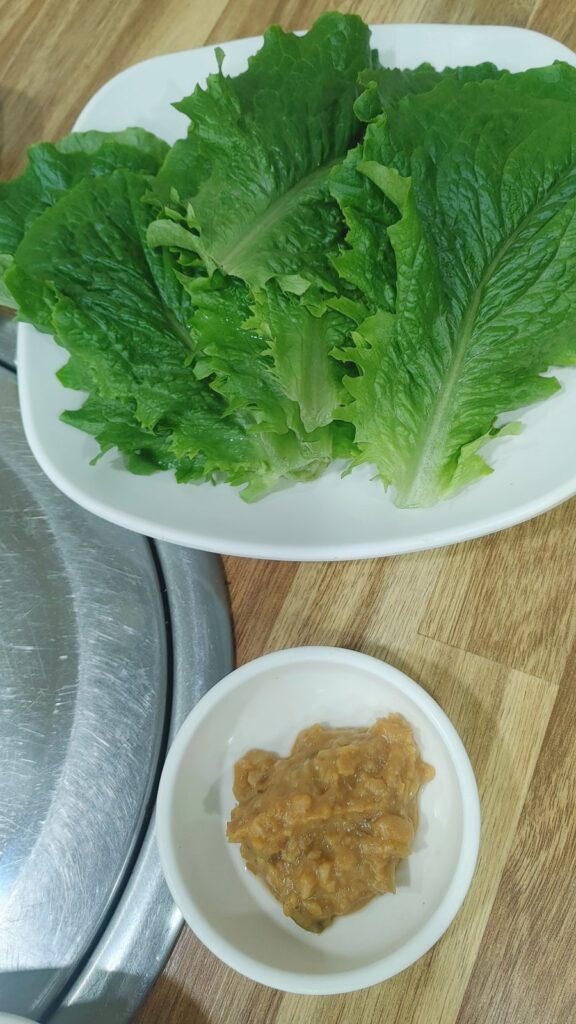
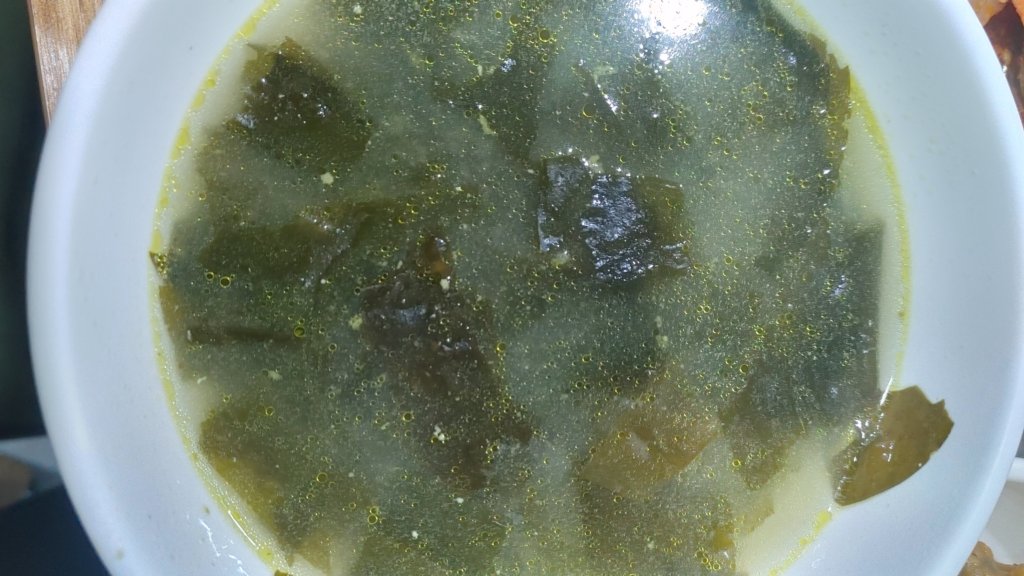
    Conclusion

    If you’re visiting Korea, I highly recommend trying jeongsik (traditional set meal). The side dishes change with each season, and I encourage you to experience the variety these seasonal banchan offer. While some dishes might be spicy, each restaurant has its own style, so don’t worry too much about it. I hope you have the opportunity to enjoy delicious Korean food today!

    Refer to