
Tag: Traditional Korean meals

  • Korean Dining Etiquette: Why Koreans Eat the Way They Do

    Korean Dining Etiquette: Why Koreans Eat the Way They Do


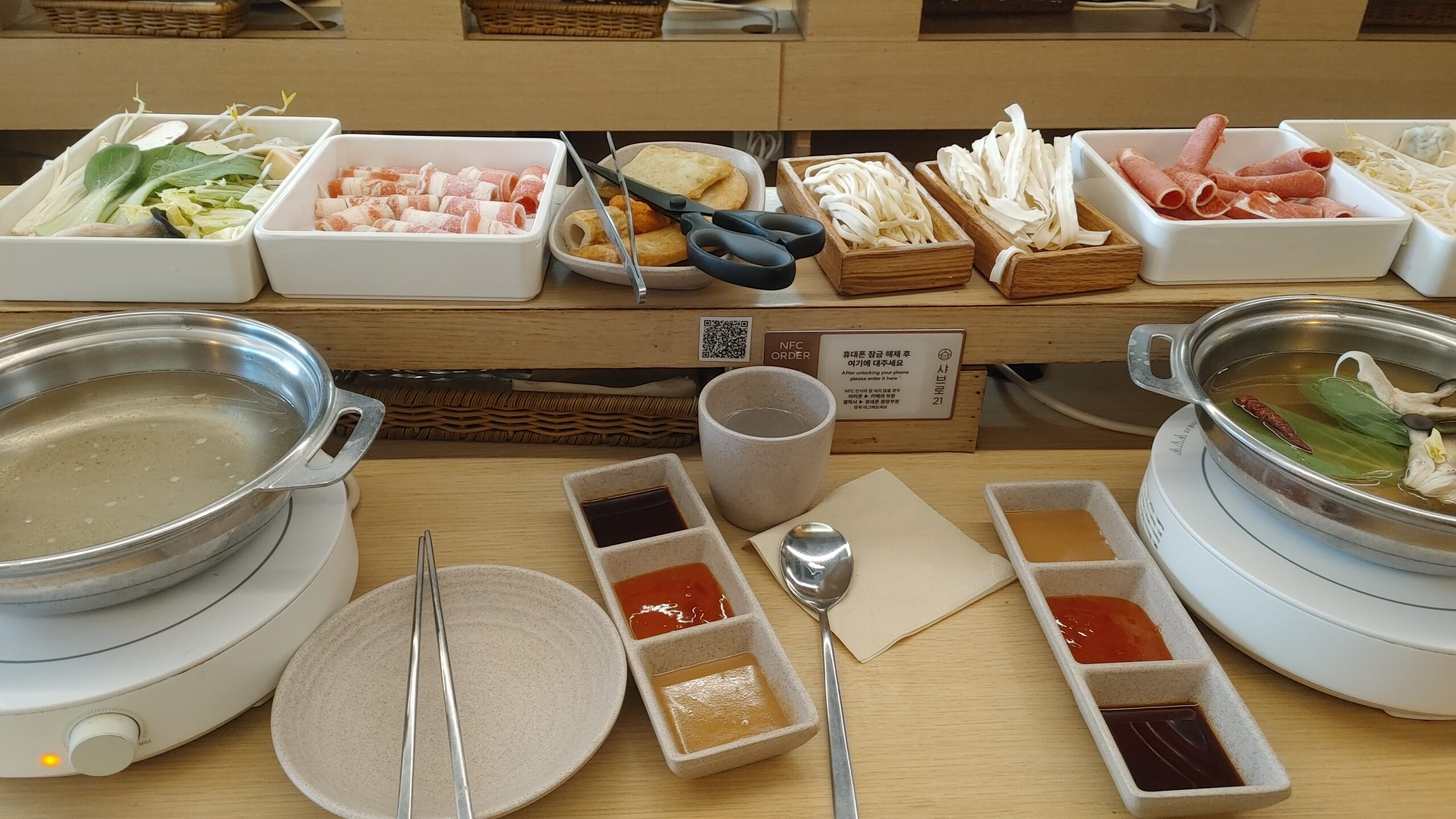
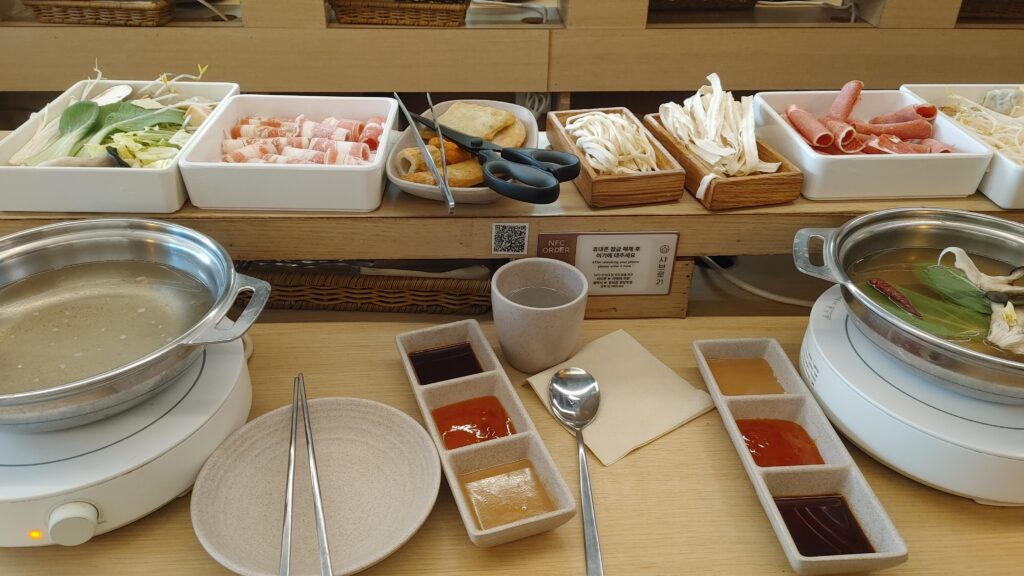
    with my sons - With my son at a single-serving shabu-shabu restaurant - Location: Hongdae Station
    with my sons – With my son at a single-serving shabu-shabu restaurant – Location: Hongdae Station

    Korean dining etiquette is unlike anything else in the world — distinct not only from Western table manners, but also from those of neighboring China and Japan. A traditional Korean table is set with an abundance of side dishes, everyone shares a communal stew from the same pot, and the order in which you pick up your spoon actually matters. So how did Korean dining etiquette come to be this way — and what does it tell us about Korean culture?

    The Unwritten Rules at the Korean Table

    Even as Korean food culture has evolved over the decades, certain foundational rules at the dinner table remain deeply embedded in everyday life. These aren’t arbitrary customs; they are the living expression of Confucian values that have shaped Korean society for centuries.

    Growing up in a Korean household, I experienced this firsthand. Every evening when my father came home from work, my mother would have dinner ready. The children were expected to be seated at the table first. Only when my father sat down and reached for his spoon — his sujeo — would the rest of the family begin eating. The eldest or most senior person at the table always lifts their spoon first. No one eats until they do.

    This simple act carries tremendous meaning: it is a gesture of respect for the person who provides for the family, a quiet acknowledgment of the day’s hard work. It is rooted in Confucian tradition, and for many Korean families, it is still observed today.


    No Loud Eating, No Heated Arguments

    One of the most distinctive aspects of Korean table manners is the expectation of quiet, mindful eating. Koreans are taught from a young age not to make noise while chewing and to keep their mouths closed when eating. There is an old saying that eating with your mouth open will drive away good fortune (bok) — so Koreans tend to eat carefully and quietly.

    Conversation at the dinner table tends to be gentle and measured. The eldest typically leads the discussion, and exchanges often resemble a soft check-in — the elder asks, the younger responds. Heated debates and arguments at the dinner table are considered inappropriate. The meal itself is the priority.

    In my childhood home, my mother always set aside the first scoop of freshly cooked rice — the warmest, most fragrant portion — specifically for my father’s bowl. She kept it warm in the rice cooker until he arrived home. It was a small act, but it spoke volumes: a daily ritual of love and gratitude from a wife to a husband who worked hard to support a family of six.


    Why Koreans Use Both a Spoon and Chopsticks
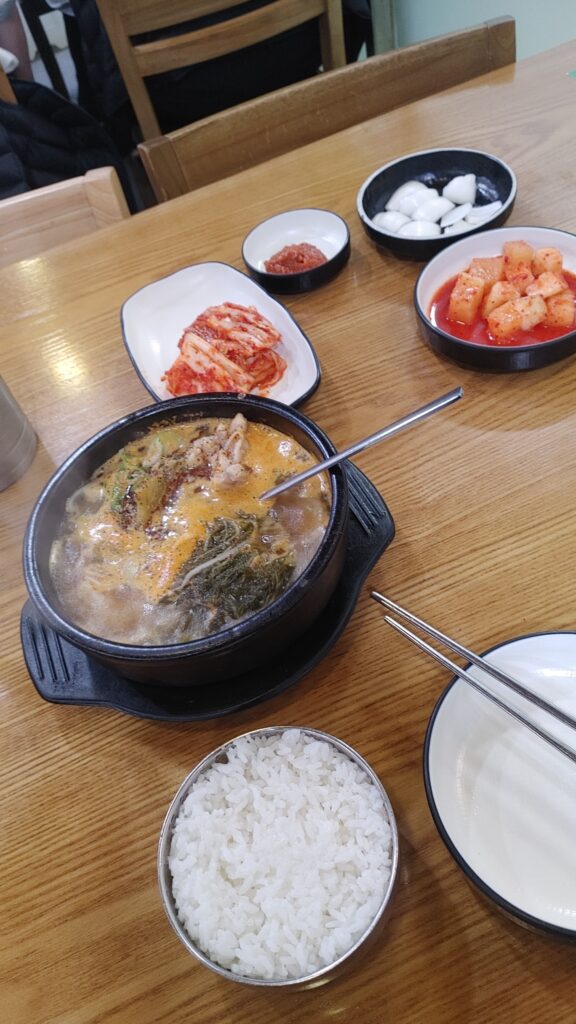
    Today Lunuch - Korean dining etiquette table setting
    Korean-style tripe soup for lunch – Location: Yeouido, South Korea

    If you’ve ever sat down at a Korean restaurant and noticed both a long-handled metal spoon and metal chopsticks beside your bowl, you may have wondered — why both?

    According to the Korea Cultural Promotion Institute, the combined use of the spoon (숟가락, sutgarak) and chopsticks (젓가락, jeotgarak) — collectively called sujeo — evolved directly from Korea’s soup-centered food culture and its grain-based diet.

    • The spoon is used for rice and broth. Korean meals are built around guk (soup) and jjigae (stew), making a spoon indispensable for scooping liquid-heavy dishes.
    • The chopsticks are used to pick up side dishes (banchan) and solid foods.

    This is what sets Korea apart from Japan and China, where chopsticks alone are typically used for rice. Korean rice, while slightly sticky, is eaten with a spoon alongside a bowl of soup — a habit refined over many centuries of Korean culinary tradition.

    Another reason for metal utensils goes back to the royal court and Joseon Dynasty (1392–1897), when silver spoons and chopsticks were used specifically to detect poison in food. Silver reacts visibly to certain toxins, making it a practical safety measure for those serving royalty. The preference for metal utensils eventually spread throughout Korean society, reinforcing hygiene standards — metal is easier to sanitize than wood, especially in a culture centered around broth and soups.


    The Art of Setting a Korean Table

    In traditional Korean table setting, every item has a designated place:

    • Rice bowl is placed to the left.
    • Soup bowl goes to the right of the rice.
    • Spoon and chopsticks are placed to the right side of the soup bowl.
    • Banchan (side dishes) are arranged in the center of the table so everyone can reach them comfortably.
    • Special or freshly prepared dishes are placed at the center front — the position of honor and easy access.

    This arrangement is not accidental. It reflects a philosophy of communal generosity — the food belongs to everyone at the table. Sharing banchan from common dishes is a hallmark of Korean dining culture, one that often surprises Western visitors who are accustomed to individual plating.

    Traditionally, Korean families ate seated on the floor (jwasik culture), with a low table set on the warm ondol floor. As modernization brought Western-style furniture into Korean homes, dining chairs and elevated tables gradually replaced the floor-sitting tradition — though the values underneath remained the same.


    “Let’s Grab a Meal Together Sometime” — More Than Just Food

    In Korean culture, the phrase “언제 밥 한번 같이 먹자” (“Let’s eat together sometime”) carries far more weight than a casual lunch invitation. It is an expression of wanting to connect, to share, to build a relationship.

    Korean meals serve as the backdrop for nearly every significant social interaction:

    • Family bonding — parents checking in on children, spouses catching up after long days.
    • Friendship and community — school moms gathering at a restaurant to share parenting advice over doenjang jjigae.
    • Romance — couples sharing their first meals together as a way of deepening emotional intimacy.
    • Business relationships — deals discussed, trust built over shared samgyeopsal and soju.

    Eating together is the fundamental social glue of Korean life. Sharing food — especially food you’ve cooked yourself — is one of the most powerful ways to say: “I care about you.”


    The Rise of “Honbap” — Eating Alone

    Yet something is shifting. In 21st-century Korea, the phenomena of honbap (혼밥, eating alone) and honsul (혼술, drinking alone) have become increasingly mainstream — especially in major cities like Seoul. Rapid urbanization and industrialization have reshaped the rhythms of daily life, pulling families apart and pushing meals into the individual sphere.

    When I was a child, it was common for friends or my father’s colleagues to be invited into our home for a shared meal. Today, that kind of hospitality has largely moved to restaurants. Even within families, eating together has become a special occasion rather than a daily habit. We hear phrases like “Let’s make more time to eat together as a family” — a sign that something once taken for granted is now something we have to consciously protect.

    The individualization of Korean meal culture is real. But the longing for connection at the table remains.


    Keeping the Tradition Alive, One Meal at a Time

    As a father of two, I make it a point to cook for my children whenever I can. The food might not be restaurant-quality, but it’s food I’ve chosen with care — made with simple, wholesome ingredients, free from anything harmful. More importantly, it’s food made with intention and love.

    Korean dining etiquette isn’t just a set of rules about where to place your spoon. It is a living record of how Koreans have expressed respect, love, hierarchy, and community through the act of eating. Understanding these traditions gives you a far richer window into Korean culture than any guidebook can offer.

    The next time someone says “밥 한번 먹자” to you — take them up on it. There’s a whole world of meaning in that shared meal.

    💡 Part of our Guide to Korean Dining Culture This article is a deep dive into Korean Dining Etiquette. It explores how Confucianism and communal values shape the way Koreans eat, from the use of metal chopsticks to the philosophy of sharing.

    Related artices


    Q: Is it okay to lift your bowl while eating in Korea?

    A: No, in traditional Korean etiquette, lifting your rice or soup bowl is considered impolite. This is a key difference from Japanese dining culture. Bowls should remain on the table, and you should use your spoon to eat.

    Q: Why are Korean chopsticks usually made of metal?

    A: Historically, silver was used in the royal court to detect poison. Today, metal is preferred for its hygiene and durability, especially when eating or wash dishes
  • Why soup is served in korean meals : A Cultural Deep Dive

    Why soup is served in korean meals : A Cultural Deep Dive

    why soup is served in korean meals

    In Korea, soup is called guk

    Traditionally, the basic menu for setting a Korean table has centered around rice and soup. And then we prepare the day’s side dishes or a main dish. At the very least, during mealtime in Korea, there must be either soup or stew—one of the two. And to this, we add kimchi and various other side dishes. In other words, without broth on a Korean table, it feels quite empty. That’s why from my mother’s time, whenever preparing a family meal, she always made soup.

    Soup was considered so important that this saying even emerged and is still used: “There’s not even broth left.” In Korean, when we say there’s not even broth left, it means there’s nothing at all. It means I won’t extend any more goodwill to the other person, and there’s nothing left for me. As a result, it means I won’t maintain the relationship anymore—in short, it signifies a complete break with you.

    This shows how we can glimpse the status of soup even in our language habits. Even in modern society, Koreans always prepared soup for meals. In my father’s time, and in my time as I became a father, Korean tables always have soup. The elderly used to say, “Without soup, you can’t eat rice.”

    Korean cuisine has particularly well-developed soup culture, and there are many varieties. We make soups using seasonal ingredients, and there are several soups we specially prepare for holidays or special occasions. On birthdays we eat seaweed soup, on New Year’s we eat rice cake soup, and on Chuseok we eat taro soup. Also, after drinking with friends, we eat hangover soups like bean sprout soup, dried pollack soup, haejangguk, or sundae soup to detoxify our alcohol-laden bodies. If you add all the regular soups we normally eat, the varieties of soup are incredibly diverse.

    According to my nephew who lives alone in Seoul while working, he used to mainly eat out before, but now he says restaurant food doesn’t taste good, so he cooks soup and rice himself at home.

    It’s said that in the 18th-19th century, the Korean king alone ate 64 different types of soup. So you can see how developed soup culture was in Korea.

    Is soup culture really a unique characteristic of Korean food?

    It’s clear that we love brothy foods including soups. And it’s also undeniable that Korean cuisine has many brothy foods including soups and stews. But does that mean we can say soup culture is a unique characteristic of Korean food? I don’t think so.

    Because various forms of soups and similar foods exist worldwide. Even in Western cuisine alone, there are various soup dishes and brothy foods. What immediately comes to mind is the soup that Europeans enjoy eating. European soups come in many varieties—there’s thick soup, stew with meat and vegetables, porridge, and broth. There’s clear consommé, thick chowder, and purée made by boiling and mashing vegetables.

    Chinese and Japanese cuisine are similar. Boiling and steaming cooking methods are used as basic recipes not only in Korea but throughout Asian cooking. Chinese and Japanese people also eat many types of tang, like our soup. In Asia, the form of boiling food in water and adding various ingredients is similar.

    Why soup culture is somewhat unique as a characteristic of Korean food?

    In Korean history, there’s a term called “il-sik sam-chan” (一食三饌). This means preparing one bowl of white rice with three side dishes for a meal. Soup is not included in this count. Soup is basically assumed to be part of il-sik sam-chan. For example, if I prepare dinner for my child today, I’d make rice, bean sprout soup, braised anchovies, braised beans, and seasoned vegetables, and for the remaining one dish I might add stir-fried spicy pork. In other words, in Korea, soup is included with rice. Rice and soup are not separated in a meal but integrated as one.

    When you go to a restaurant while traveling in Korea, the basic table setting places soup to the right of the rice. This is because it’s cultural. An easy way to understand it is to think of soup as food with liquid that’s generally made by boiling in water.

    While the West and Japan think of soup as separate, Korean rice and soup should be seen as a fused relationship that becomes one.

    Another reason Koreans prefer soup is not actually because we can’t eat rice without soup, but because rice and soup give such a sense of unity in a meal. We don’t find the characteristics of Korean food culture in soup simply because Koreans like brothy foods or because there are many types of brothy foods.

    For example, when eating samgyeopsal or spicy food, we serve mildly seasoned soups like bean sprout soup or seaweed soup alongside to soothe the spiciness from the food.

    When did soup culture develop?

    Historically, it appears our people (Korea) have enjoyed various soup dishes since ancient times. In terms of linguistic interpretation, what we call “guk” in Korean—food made by putting various ingredients in water or other liquids and boiling them—was expressed in Chinese characters as “tang” (湯). But in very ancient times, they distinguished more precisely and the names were really different. This story goes back to around the 1300s.

    Since these were ancient foods that existed before Hangul was created, we don’t know what they were called in pure Korean, but they remain in Chinese characters.

    Looking at documents from the Goryeo and Joseon periods in Korean history, it seems our ancestors really loved soup. The 18th-century Joseon scholar Seongho Yi Ik left this writing: “Bibimbap never gets boring no matter how much you eat it, but for filling your stomach, gukbap (soup with rice) is the best.” Historically, the Korean people were famous for enjoying bibimbap, but they equally enjoyed gukbap—that is, soup and rice. Back then, food wasn’t as abundant as it is now.

    Why did soup culture develop?

    Looking at Korea, Asia, and various countries, unique food cultures have taken root. The formation of these food cultures is influenced by various factors. Particularly, the country’s historical, economic, geographical, and climatic characteristics must have intertwined comprehensively to create a unique soup culture.

    As with any country, soup basically emerged as a way to eat food deliciously. In other words, in the process of food development, foods like soup and stew emerged either independently or dependently with other dishes.

    Another reason is to eat more rice. This may sound strange to modern people, but from an old perspective, the characteristics of Korean food are contained in soup culture. Some argue that soup is a product of poverty. They claim that because the Korean peninsula has many mountains and narrow terrain, grains weren’t abundant, so soup developed in the process of adding water to limited ingredients and boiling them to increase the quantity.

    However, historically, Korea was not a chronically food-scarce poor country. Also, soup actually promoted grain consumption. Unless it’s a separate dish like Western soup, having soup makes you eat more rice. In that sense, soup was a food of abundance and an upper-class dining culture. So the biggest reason soup culture developed in Korea can perhaps be found in rice, our staple food.

    Korean food culture developed centered on rice. In the West, it developed centered on bread. We eat kimchi as a basic side dish along with meat and various side dishes, all centered on rice and soup. Most side dishes also seem like supplementary foods to help us eat delicious rice-cooked meals in larger quantities. Also, borrowing my wife’s words about meals, side dishes play various roles in supplementing missing nutrients. These side dishes are also prepared differently according to the seasons.

    From a regional perspective, Korea’s ondol culture of always boiling water in cauldrons, along with climatic and environmental factors—cold and dry winters, hot and humid summers—probably also played a role. By eating hot broth, we warm our bodies, and even in summer, we can feel coolness by sweating sufficiently, so soup is consumed as an efficient food to endure the sweltering heat.

    Korean soup culture was formed not simply at the level of eating delicious food, but by Korean life and natural conditions all melting and mixing together. The reason soup emerged wasn’t just one reason but varied according to history, natural environment, and culture. Even now in Korea, soup is the most basic food that comes to the table.

    What do we mainly eat this winter?

    welcome my Tastykoreanfood youtube – link

    In cold winter, we mainly prepare soups that warm the body. The methods also differ from household to household. We try not to use sugar in these as much as possible.

    In cold winter, there are various options: bean sprout soup (soup made by boiling bean sprouts with a bit of salt), seaweed soup (soup made by stir-frying seaweed in sesame oil, adding various seasonings, and boiling thoroughly), soybean paste soup, kimchi soup, beef soup, radish soup, and more. The soup I prefer is definitely radish soup, which I learned from my mother-in-law and make often. The preparation time is short, and when you eat it, you feel warmth in your chest and stomach. Because it doesn’t have many ingredients, the taste is also clean. No sugar is used

    Today Lunch is pollack soup, Sugar free

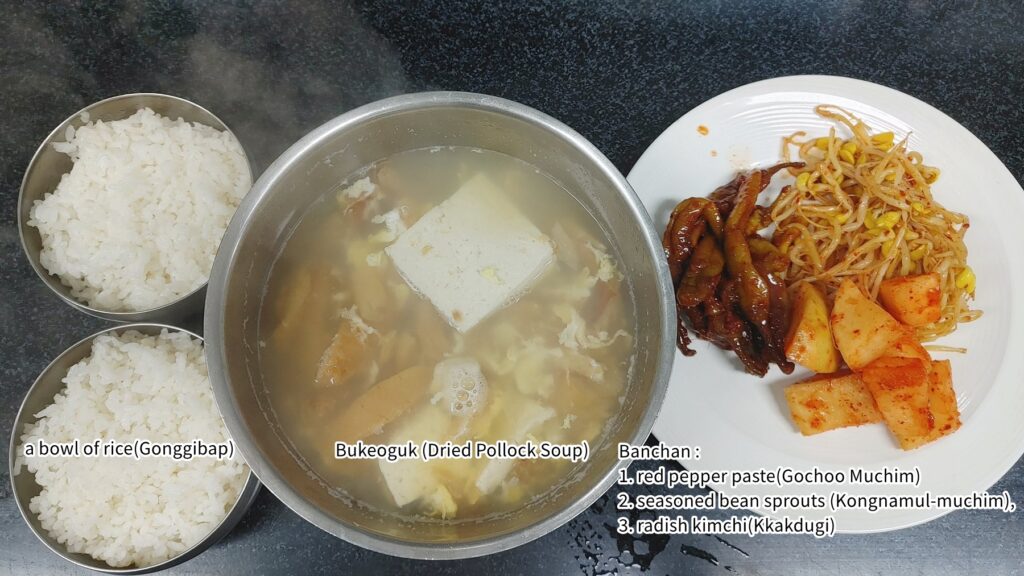
    Bukeoguk (Dried Pollock Soup) 001-20260128
    Bukeoguk (Dried Pollock Soup) 001-20260128

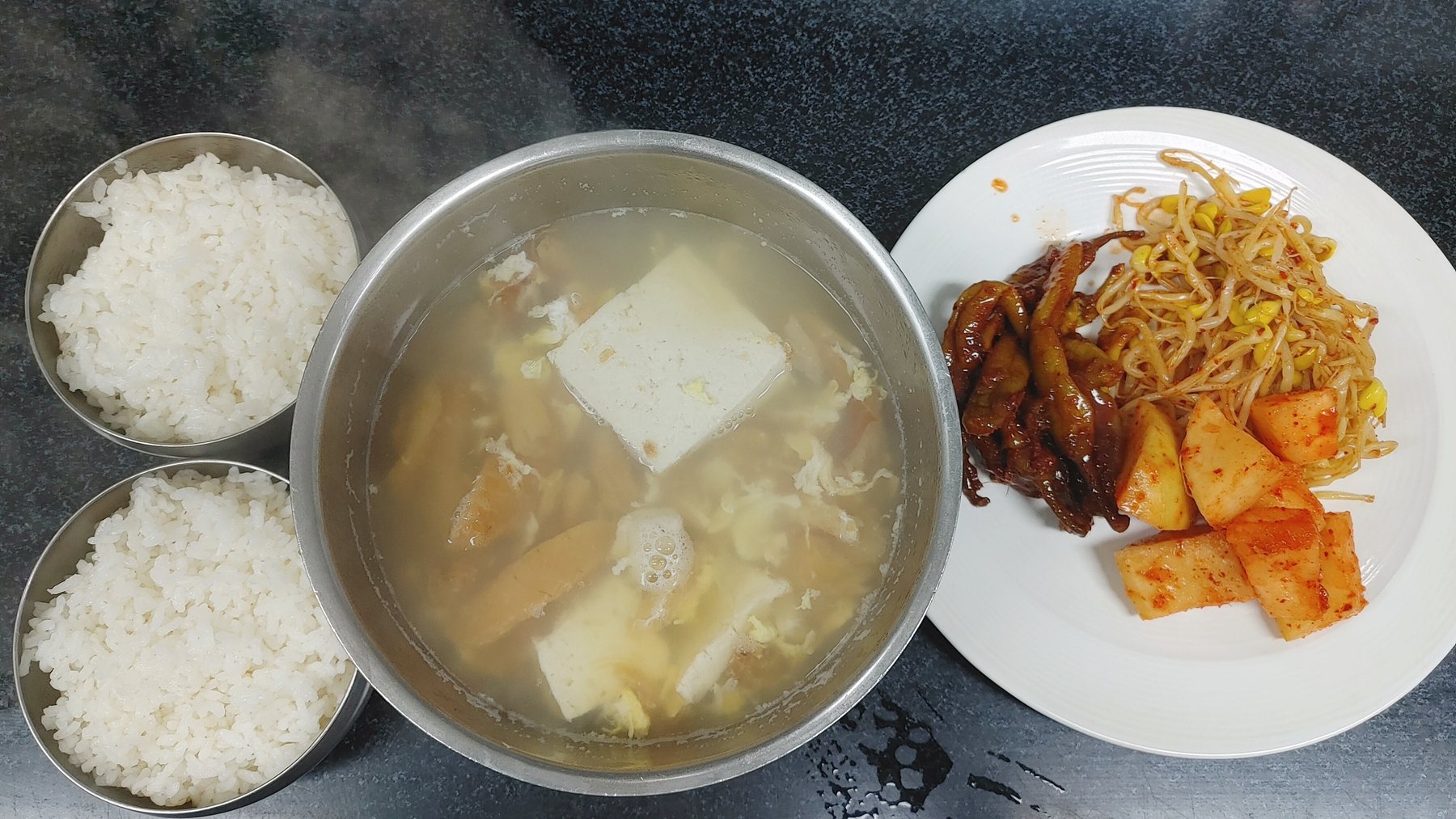
    Korea traditionnal hangover soup , Pollack Soup, We call  Buk-eo Guk

    This is the classic hangover soup I had for lunch today: pollack soup(. I added a bowl of rice, and the three side dishes are as follows: seasoned red pepper paste, seasoned bean sprouts, and cubed radish kimchi (radish kimchi) from the left, clockwise. It costs about $9.

    To understand how rice and soup function together, see What Is Korean Food, what is mitbanchan